What taxi-top DOOH is
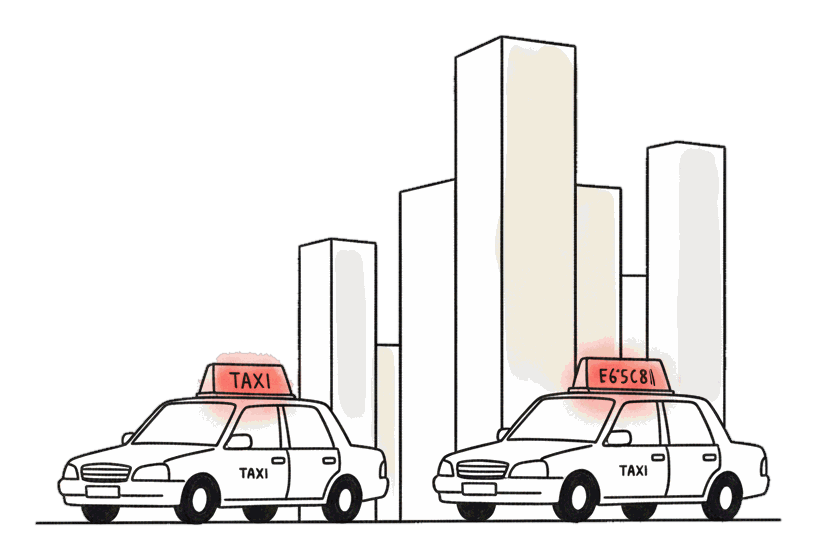
Taxi-top and rideshare advertising is a form of digital out-of-home in which the screen is mounted on a vehicle rather than a wall. The roof unit sits on top of a taxi or a rideshare car, faces outward, and shows a bright digital message to pedestrians, other drivers and people waiting at the curb as the car moves through traffic. Alongside it, in-car screens face the passenger inside the vehicle and reach a single captive rider for the length of the trip. Both are digital, both are bought per play, and both run through the same self-serve flow as a fixed billboard.
The difference from a static poster is movement. A wall billboard is a bet on one location: whoever passes that corner, at whatever hour, sees the ad. A taxi-top screen carries the message to where the people are. Over a shift, a single roof unit threads a downtown core, a transit hub, a shopping district and a nightlife strip, appearing in front of many different crowds instead of one. That is the mobile-reach advantage: instead of paying for one busy spot and hoping the right audience walks by, you put the screen into the flow of the city and let it pass through crowd after crowd.
Because the vehicle is location-aware, the message is not fixed either. The same roof unit can carry one creative while it is downtown and switch to another as it nears a venue or crosses into a target district. This guide covers the formats you can book, where the format earns its place, how it stays efficient at any budget, and exactly how to build a taxi-top plan on Blindspot. The unit underneath it all is the play, one ad appearance on one screen, priced from about $0.23 in urban markets and shown on every screen card before you book.
The formats: roof, in-car and wrap plus screen
Vehicle DOOH comes in a few shapes, and they reach different people. A roof unit maximises street-level reach; an in-car screen trades reach for dwell time with one rider; a wrap plus screen gives a vehicle a full brand presence. On Blindspot each of these is booked the same way, per play and by the hour, so you can mix them in one plan and geofence each to its own zone. The table below is how to read the field.
| Format | Movement | Geofencing & targeting | Per-play framing |
|---|---|---|---|
| Roof-top unit | Moves with traffic, reaches the street | Zone and route targeting | From $0.23, per play, by the hour |
| In-car screen | Rides with one passenger, high dwell | Trip and neighborhood zones | Per play, booked by the hour |
| Wrap plus screen | Full-vehicle presence, static plus motion | Event and district zones | Per play, efficiency at any budget |
A note on how to choose. Roof units are the workhorse of the format: they carry a short, bold message across the widest street-level audience, and they are the right pick for awareness and launches. In-car screens are quieter but deeper, one viewer, a full ride, so they suit a longer message, a QR code or an offer a rider can act on. A wrap plus screen turns a vehicle into a rolling brand statement for a launch or an event. Whichever you pick, the pricing model is the same: per play, shown up front, no thousand-impression forecast to decode.
The screens are digital, so the creative rules of DOOH apply: one idea, big type, high contrast, and motion used sparingly. A message that reads in a second or two from across a street is what works on a roof unit passing at traffic speed. If you want the creative to change with the world, not just the map, that is possible too, and it is covered below.
Where taxi-top advertising shines
The format earns its place wherever the audience is on the move and concentrated. Three settings stand out.
Dense metros. In a packed city core, a roof unit does what a wall cannot: it keeps moving through the crowd. Foot traffic in a downtown, a financial district or a shopping street is dense and shifting, and a screen that travels with it racks up appearances in front of many different groups across a single shift. This is where mobile reach compounds fastest, because there is always a new crowd a block away.
Events. A concert, a match, a conference or a festival pulls a large, focused audience into one place for a window of hours. Taxi-top and rideshare screens naturally cluster around venues as riders arrive and leave, so a fleet geofenced to the streets around a stadium during the evening event window reaches exactly the people who came for it, then moves on when they do. Layer a live trigger on top, and the creative can respond to the moment as well as the place.
Launches. When a product, a store or an app opens, the goal is to own a district for a short, intense burst. A moving screen lets you saturate the streets around a launch venue during opening days without renting every wall in the neighborhood. You point the fleet at the zone, run the busy hours, and the message follows the crowd around the launch rather than sitting on one corner of it.
What ties these together is geofencing. Because every taxi-top screen is location-aware, Blindspot lets you draw a zone on the map, a downtown core, the streets around a venue, a single neighborhood, and set a creative to run only when a vehicle is inside it. One fleet can then carry different messages in different parts of the city on the same day: a launch creative near the store, an event creative near the arena, a broad awareness message everywhere in between. It is the mobile equivalent of choosing exactly which corners your posters hang on, decided by software, changeable in a click.
A wall waits for the crowd. A taxi-top screen goes to it.
Taxi-top advertising, in one line
Efficiency at any budget
3,000,000+
screens, 50+ countries
$0.23
per play, urban floor
30%+
of a buy's waste removed
48
hours to live
Vehicle screens can feel like a premium format, but on Blindspot they are governed by the same rule as every other screen: a budget buys the real exposure it needs, not filler plays. That efficiency comes from two places, per-play pricing and hourly control, and it holds whether the budget is a first street-level test or a national flight.
Per play, not per thousand. Every taxi-top and rideshare screen is priced per play, one logged appearance on one screen, shown on the screen card before you book. There is no thousand-impression forecast to translate and no rate card to negotiate. You see what a play costs, from about $0.23 in urban markets, and you decide how many you want. A small budget knows exactly how far it reaches; a large one scales the same clean unit across cities.
By the hour, not the week. The biggest waste in any out-of-home buy is the hours nobody is watching. A traditional rental pays the same for a 3am empty street as for the evening rush. Taxi-top screens on Blindspot carry their own hourly schedule, so you buy the commute, the lunch window, the event hours and the nightlife peak, and drop the dead overnight and midday hours entirely. Cutting them typically removes 30% or more of a buy's waste, and the freed budget buys more plays when the streets are actually busy. How much you save scales with how peaked your audience is: a nightlife or event brand saves more than an all-day one.
This is the same efficiency a large brand uses to make a global flight work as hard as a first campaign. On a worldwide tourism campaign, Blindspot ran 4,067 screens and reached more than 97 million people over 51 days, and by concentrating delivery into peak windows the campaign delivered 2,146,892 plays, 87% more than planned. The full breakdown is in the Visit Maharashtra case study. The mechanism is identical on a single taxi-top fleet in one city: put the plays where the crowd is, and stop paying for the hours when it is not. And because there is no minimum spend, the format is open to a first test just as much as a national buy.
How to buy taxi-top advertising on Blindspot
Buying a moving screen works exactly like buying a fixed one, because it runs through the same fully self-serve platform. There is no media buyer and no sales call. You open the map, filter to taxi-top and rideshare screens, and the available screens appear with their per-play price and live availability. You pick the ones you want, set the hours each should run, draw the geofence zones for where a creative should appear, upload the creative, and publish. The running cost updates as you build, so you always see the number before you commit.
If you would rather not build a fleet plan screen by screen, Blinky, the free agentic AI planner, reads a one-line brief and proposes a taxi-top plan for you, which screens, which hours, which zones, drawing on more than 7 million data points about how audiences move through a place. You then adjust it and publish. Either way, each screen is approved by its operator in roughly two business days, and the campaign goes live in about 48 hours.
Timing does not have to stop at the clock and the map. On top of the hourly schedule and the geofence, Blindspot lets a creative fire on live conditions, so a taxi-top ad can respond to the world as well as the street. The live triggers available today include weather and temperature, air quality (AQI), stock and crypto prices, live sports scores, and a custom live-data API. You could run an iced-drink creative on the roof units in a district only when it is above a set temperature, or a match-day message near the arena only while the game is on. See the weather-triggered advertising guide for how the triggers work, or browse screens and start building. To see the format alongside fixed transit and station screens, read the transit advertising guide, or book a billboard to walk the flow end to end.