Why Maharashtra Tourism bought DOOH in 20 cities and not one airport
Maharashtra Tourism didn't want a poster in one airport. It wanted the state to feel present everywhere its future visitors already are: in the great cities of five continents, on the screens travelers pass on the way to book a trip.
The brief carried three jobs, and each had to be provable. Reach a global audience in every market. Deliver the plays that were promised. Do it on premium screens, at volume, with no second-tier or remnant screens. Delivered with SignPost India on Blindspot's programmatic platform, the plan was built to be measured against those goals from day one, not admired after the fact.
Quotable, self-contained, sourced · Maharashtra Tourism × Blindspot, June 2026
- Maharashtra Tourism ran a worldwide out-of-home (DOOH) campaign on Blindspot, delivered with SignPost India, live 1 May to 20 June 2026 (51 consecutive days, zero dark days) across 20 cities in 15 countries on five continents.
- The flight ran on 4,067 premium screens across 1,277 networked locations, airports, metro, rail, spectaculars and street billboards, and reached 97M+ people. Verified delivery was led by London (380,215 plays), New York (360,419) and Los Angeles (317,558).
- Programmatic dayparting delivered 2,146,892 verified plays against 1,150,632 planned, +87% over plan, by concentrating delivery into peak windows (evening plays peaked at 42%). Every play is logged in a geo-tagged, time-stamped proof-of-play export dated 26 June 2026.
Where the campaign ran: 20 cities, 15 countries, five continents
The map spanned 20 cities in 15 countries, across five continents, with major markets including New York, San Francisco, Los Angeles and Toronto in North America; London, Paris, Milan, Rome and Frankfurt in Europe; and Tokyo, Bangkok, Seoul, Singapore, Kuala Lumpur, Ho Chi Minh City, Hanoi, Colombo, Sydney and Melbourne across Asia-Pacific.
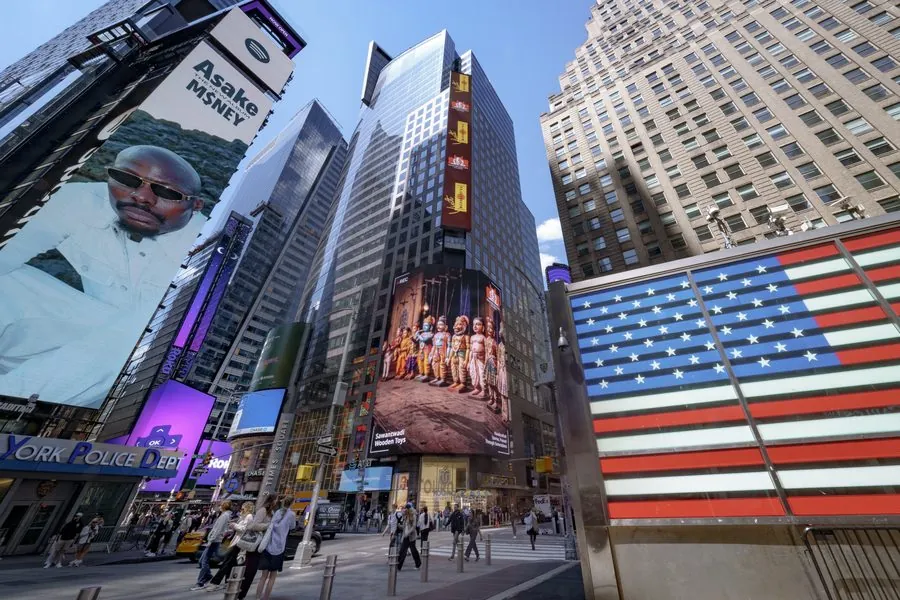
These were flagship sites, not filler. The MiFi Towers in Times Square, Sunset Boulevard in Los Angeles, Hammersmith Towers and the London Underground, Bangkok's Exchange Tower, Raffles City in Singapore, the Routemaster full-wrap buses of London, and the concourses of Heathrow, JFK, LAX, SFO, Toronto Pearson, Frankfurt, Paris CDG and Changi.
Twenty cities, fifteen countries, five continents
Every market that carried the campaign, and the eight where the buy reached inside the airport as well as across the city. Pins mark position only. Volume is in the ranked table above, because at world scale London and Paris sit fifteen units apart and a mark scaled to 380,215 against 193,575 would swallow its neighbour. Mumbai carried no screens at all: it is the destination the whole flight pointed at.
City screens City + airport concourse Mumbai · the destination, no screens Airport markets where travelers to and from India were bracketed at both ends
North America
- New York + airport
- San Francisco + airport
- Los Angeles + airport
- Toronto + airport
Europe
- London + airport
- Paris + airport
- Frankfurt + airport
- Milan
- Rome
Asia-Pacific
- Tokyo
- Seoul
- Bangkok
- Singapore + airport
- Kuala Lumpur
- Ho Chi Minh City
- Hanoi
- Colombo
- Sydney
- Melbourne
Nineteen of the twenty markets are named in the campaign reports. ● 26 Jun proof-of-play
Airport, transit and street formats, in every environment
The footprint was transit-led by design, because that is where travelers actually stand still. Airports, metro and rail carried the weight, anchored by high-impact spectaculars and city billboards in the busiest districts.
Venue mix · share of plays
Transit · airports, metro, railOutdoor · billboards & spectacularsRetail · malls, 0.5%
Every creative was approved and sized to its screen, video and static both, so a departure-hall vertical and a Times Square spectacular each ran to spec. No off-format uploads, no wrong-orientation stretch, no remnant slots filling the gaps.
How programmatic dayparting delivered 87% more plays than planned
The media plan called for 1,150,632 plays. The verified proof-of-play log recorded 2,146,892, which is 187% of plan, or 87% more than promised. In plain terms that is 996,260 plays the plan never promised, worth roughly $1.06M in added media value at the campaign's own effective rate, all inside the same budget. That gap is not an accident; it is the point of buying DOOH by the play instead of by the day.
Every play was triggered by exact location, time of day, day of week and live passenger flow. Nothing ran on a fixed loop, and nothing paid for an empty overnight concourse. Delivery was concentrated into the windows that carry an audience, and matched to the zone: departure areas ran during departure banks, arrival areas during arrival banks, so screen, zone and minute lined up with the traveler.
Reading the day-part shares as a rate rather than a total is what makes the strategy legible. The bands are not equal lengths: evening covers three hours and carries 42% of plays, night covers five and carries 4%. Per hour, that is 14% against 0.8%, a rate 17.5 times higher.
Plays per hour · derived from the day-part shares
| Window | Hours | Share of plays | Per hour |
|---|---|---|---|
| 00:00–06:00 | 6 | not bought | 0.0% |
| 06:00–10:00 | 4 | 24% | 6.0% |
| 10:00–13:00 | 3 | 9% | 3.0% |
| 13:00–16:00 | 3 | 21% | 7.0% |
| 16:00–19:00 | 3 | 42% | 14.0% |
| 19:00–24:00 | 5 | 4% | 0.8% |
Seven of twenty-four hours carried two thirds of delivery. Those seven hours are the departure and arrival banks.
Nothing ran between midnight and 06:00. An empty concourse was never paid for.
The same budget across 87% more plays. Effective cost per play dropped by almost half.
Chaining airports: four touchpoints on one trip
The European, US and Canadian airport buys were chained together, so a single trip meets Maharashtra at every stage. A flyer heading from New York or Toronto to Frankfurt, London or Paris sees the destination four times on one trip:
Travelers flying to and from India were bracketed at both ends, since they are the highest-propensity audience for a Maharashtra trip. Four touchpoints on one trip turn a single impression into a reinforced sequence, and that is the frequency that builds consideration.
Two clocks, one traveler
Both ends of a representative long-haul pairing, each on its own clock, because a single timeline would run the traveler backwards across the date line. Bar heights are the campaign's published dayparting shares divided by the real number of hours in each band, applied in each market's local time. The silhouette is the same everywhere, which is the point: the city screen and the airport screen fired inside the same bank. What moves between the panels is which bank is lit. The two windows shown are the campaign's two largest published bands, standing in for a morning departure and an evening arrival; exact bank times were set per airport.
Departure bank06:00-10:00 · 24% of plays
Arrival bank16:00-19:00 · 42% of plays
29% of the clock66% of the plays00:00-06:00 bought nothing
| Stage | Screens | Window | Share of plays |
|---|---|---|---|
| 01 · On the way | City billboards on the route to the airport | Departure bank, 06:00-10:00 | 24% |
| 02 · At departure | Check-in, security and gate screens | Departure bank, 06:00-10:00 | 24% |
| 03 · On arrival | Baggage claim and arrivals halls | Arrival bank, 16:00-19:00 | 42% |
| 04 · Into the city | Transit and street screens on the way in | Arrival bank, 16:00-19:00 | 42% |
City screens only fired when the street was busy
The city billboards were not a separate buy running on a loop. They were triggered by the same rules as the airport screens, on exact location, time of day, day of week and live passenger flow, so a screen fired only when the street it stood on was actually moving, and it fired inside the same departure and arrival banks as the airport it fed. The curve below is delivery by hour set against what a flat 24/7 loop would have bought with the same money.
Share of plays by hour · against a flat 24/7 loop
10 hours carried 87% of the playsa flat loop would spend 58% on the 14 hours that carried 13%00:00-06:00 never fired
| Window | Hours | Share of plays | A flat loop | Difference |
|---|---|---|---|---|
| 00:00-06:00 | 6 | 0% | 25% | -25 pts |
| 06:00-10:00 | 4 | 24% | 16.7% | +7.3 pts |
| 10:00-13:00 | 3 | 9% | 12.5% | -3.5 pts |
| 13:00-16:00 | 3 | 21% | 12.5% | +8.5 pts |
| 16:00-19:00 | 3 | 42% | 12.5% | +29.5 pts |
| 19:00-24:00 | 5 | 4% | 20.8% | -16.8 pts |
The campaign's own read: city screens drew higher engagement than airport screens, with proximity, dwell and repeat exposure beating terminal footfall. ● Blindspot/SignPost campaign report


Verified DOOH delivery, play by play
The whole campaign was built to be counted, and the counts came in above plan on every line that mattered:
4,067
premium screens live, across 1,277 networked locations
2,146,892
verified plays, +87% over the 1,150,632 planned
97M+
real people reached across five continents
20
cities on the map, in 15 countries
51/51
days live, zero dark days start to finish
85%
of plays on transit screens: airports, metro and rail
North America, led by New York and Los Angeles, drew the biggest share of plays; Europe, led by the Paris and Frankfurt airports, held the most screens. Street-level billboards and city screens out-engaged airport screens, where proximity, dwell and repeat exposure beat sheer terminal footfall.
Every number here, and where it comes from
A case study is only worth the evidence under it, so this is the whole measurement chain in one place, including what the campaign does not claim.
- Play
- One display of one creative on one screen. It is the unit the campaign was bought and billed on, and the unit every delivery figure on this page counts. A play is not an impression and not a person.
- Proof of play
- The log written when a screen actually displays a creative. Each of the 2,146,892 records in this campaign's export carries a latitude, a longitude and a timestamp, so any play can be traced to a specific screen at a specific minute.
- Daypart
- A named window of the day that media is bought against. This campaign bought five of them and left 00:00 to 06:00 unbought entirely.
- Reach
- People, not plays. The 97M+ figure is compiled from operator audience figures for the booked screens. It is the one number on this page that is not counted from the proof-of-play log, and it is quoted separately for that reason.
The export was taken on 26 June 2026, six days after the flight closed, and covers 1 May to 20 June 2026. Delivery was reported weekly throughout, with operator certificates alongside the log.
What this page does not claim. There is no attribution modelling here, no panel estimate and no footfall study. Plays are counted, reach is compiled from operator figures, and the two are never added together. Where a figure is derived rather than reported, the derivation is shown next to it.
Industry context matters here, because the category is still settling on how any of this should be counted. The IAB only published its Digital Out-Of-Home Measurement Guide in July 2025, and a central theme of it is moving the category off blunt opportunity-to-see counting toward viewability-adjusted impressions and a shared measurement foundation. This campaign was bought, counted and billed on the individual play throughout, with a geo-tagged timestamp behind each one. The full method, including what it cannot tell you, is set out in how Blindspot measures DOOH, also available as a PDF.
There is no published industry figure for delivery against plan to set this beside. We looked. The category has no shared proof-of-play standard, and the IAB only issued its first DOOH measurement guidance in July 2025, so a cross-industry average does not yet exist to be quoted. That is why the comparison above is drawn from the two bars that can be checked: the threshold the contract actually set, and what Blindspot delivers across its own campaigns. On a booked buy, landing at 98% of plan is the normal, healthy outcome, because a plan is a commitment rather than a forecast. Delivering 187% of it is not a better version of the same result. It is a different one.
The pattern is reusable, and it is not about Maharashtra
Two mechanics did the work here, and neither is specific to this destination or this budget. Any tourism board buying international DOOH can apply both.
1. Chain the trip, do not buy the city. A traveler is reachable at four separate moments on one journey: on the way to the airport, inside the departure terminal, in the arrivals hall at the other end, and on the way into the destination city. Buying those four as one sequence turns a single impression into a reinforced one. Buying them as four unrelated line items does not. The requirement is that the city screens and the airport screens sit in the same plan, on the same trigger rules, rather than being bought by different teams against different windows.
2. Gate delivery on live conditions, not on a clock. A fixed 24/7 loop spends the same money every hour whether anyone is present or not. Triggering each play on location, time of day, day of week and live passenger flow moves that money into the hours that carry an audience. On this campaign 10 hours carried 87% of the plays, and a flat loop would have spent 58% of the budget on the 14 hours that carried 13%. The saving is not a discount, it is the same budget buying more of what works.
Neither mechanic requires a bigger budget. Both require buying by the play instead of by the day, and both require the proof-of-play log to check the buy actually behaved the way it was planned to.
What to take from a worldwide DOOH campaign: awareness is a plan, not a poster
Putting a destination in front of 97 million people did not take a bigger budget or a longer contract. It took the right screens in the right cities, bought by the play and concentrated into the hours travelers are actually watching, then chained across the trip so one flyer meets the message four times.
Buy the world's best screens. Then run them only when they count.
The Maharashtra campaign, in one sentence
DOOH campaign questions, answered
What was the Visit Maharashtra global DOOH campaign?
The Visit Maharashtra campaign was a worldwide digital out-of-home (DOOH) flight run by Maharashtra Tourism to build awareness of the Indian state among international travelers. It was delivered on Blindspot's programmatic DOOH platform together with SignPost India, and ran for 51 consecutive days from 1 May to 20 June 2026. The campaign placed the destination on 4,067 premium screens across 1,277 networked locations in 20 cities and 15 countries on five continents, from the MiFi Towers in Times Square and Sunset Boulevard in Los Angeles to Hammersmith Towers in London, Shibuya in Tokyo, and the departure and arrival halls of major hub airports. It reached more than 97 million people and delivered 2,146,892 verified plays, all logged in a geo-tagged, time-stamped proof-of-play record. The creative line, 'You will find India here', ran as both video and static formats, each one sized to the screen it played on.
How large was the campaign, and where did it run?
The campaign ran across 20 cities in 15 countries on five continents. Major markets included New York, San Francisco, Los Angeles, Toronto, London, Paris, Milan, Rome, Frankfurt, Tokyo, Bangkok, Seoul, Singapore, Kuala Lumpur, Ho Chi Minh City, Hanoi, Colombo, Sydney and Melbourne. It used 4,067 premium screens across 1,277 networked locations, weighted toward transit environments: airports, metro and rail carried about 85% of plays, billboards and spectaculars 14%, and retail the rest. Iconic placements included the MiFi Towers in Times Square, Sunset Boulevard in Los Angeles, Hammersmith Towers and the London Underground, Bangkok's Exchange Tower and Raffles City in Singapore, plus the concourses of Heathrow, JFK, LAX, SFO, Toronto Pearson, Frankfurt, Paris CDG and Changi. By verified plays, the campaign was led by London, New York and Los Angeles; Europe held the most screens, while North America delivered the largest single share of plays.
How did the campaign deliver 87% more plays than planned?
The media plan called for 1,150,632 plays. The verified proof-of-play log recorded 2,146,892, which is 187% of plan, or 87% more than promised. The gain came from how Blindspot buys DOOH: by the individual play, triggered by exact location, time of day, day of week and live passenger flow, rather than renting a screen around the clock. Empty overnight hours were cut, and delivery was concentrated into the windows that actually carry an audience. Departure zones such as check-in, security and gates ran during departure banks, while arrival zones such as baggage claim ran during arrival banks, so each play met a traveler at the right moment. Evening was the strongest window, at 42% of plays. Concentrating the same flight into high-yield windows and zones is what nearly doubled delivery.
How were the campaign's results measured and verified?
Every headline number is backed by evidence rather than estimates. Plays are counted from a geo-tagged, time-stamped proof-of-play log with more than 2.1 million records, exported on 26 June 2026; each play carries a latitude, longitude and timestamp. Reach of 97 million-plus people is compiled from operator audience figures for the booked screens. Delivery was reported weekly throughout the flight, with geo-tagged proofs and operator certificates, and analyzed city by city. The campaign ran 51 of 51 days live with zero dark days. Because reach draws on operator audience figures and plays on the proof-of-play log, each metric can be traced back to its own source. This is the same verified reporting every Blindspot campaign produces.
What is DOOH advertising?
DOOH stands for digital out-of-home: advertising on digital screens in public places, such as airport concourses, metro and rail stations, roadside billboards and large-format city spectaculars. Unlike printed out-of-home, a DOOH screen shows a rotation of creatives, so the media is bought and counted as individual plays rather than as one poster site rented for a fixed period. This campaign ran on 4,067 DOOH screens across 1,277 networked locations.
What is proof of play in DOOH?
Proof of play is the log a screen network writes when a creative is actually displayed. Each record ties one play to one screen at one moment. The export for this campaign holds 2,146,892 records, and each carries a latitude, a longitude and a timestamp, so any single play can be traced back to the screen that ran it and the minute it ran. Proof of play is what separates verified delivery from an estimate.
What is dayparting, and how did it nearly double delivery?
Dayparting is buying media against named windows of the day instead of across the whole clock. This campaign bought five windows and left 00:00 to 06:00 unbought entirely. Ten hours of the day carried 87% of all plays. A fixed 24/7 loop spends the same money every hour whether an audience is present or not, so moving that spend into the hours that carry people is what turned 1,150,632 planned plays into 2,146,892 delivered on the same budget.
How is DOOH reach different from plays?
A play is one display of one creative on one screen. Reach is a count of people. The two are measured differently and should never be added together. On this campaign plays are counted from the proof-of-play log at 2,146,892, while reach of more than 97 million people is compiled from operator audience figures for the booked screens.
Does airport advertising work for tourism boards?
An airport audience is already travelling, which is the behaviour a destination is trying to influence, so the intent match is unusually good. This campaign ran airport concourse screens in eight markets and chained them to city screens at both ends of the trip. The campaign's own read was that city screens drew higher engagement than airport screens, with proximity, dwell and repeat exposure beating terminal footfall, so the strongest result came from running both together rather than choosing between them.
How is a campaign like this priced?
By the play. Blindspot buys and bills individual plays rather than renting a screen for a period, so the working metric is average cost per play. Because the same budget delivered 2,146,892 plays against the 1,150,632 planned, the effective cost per play on this campaign fell by 46.4%.
Which airports did the campaign run in?
Airport concourse screens ran at London Heathrow, New York JFK, Los Angeles LAX, San Francisco SFO, Toronto Pearson, Frankfurt, Paris Charles de Gaulle and Singapore Changi. Those eight markets also carried city screens, so a traveler met the destination before reaching the airport and again after leaving it.
Can a tourism board repeat this in other markets?
The two mechanics behind the result are not specific to this destination. Chaining the trip means buying the city screens on the route to the airport, the departure concourse, the arrivals hall and the transit into the destination city as one sequence rather than four separate line items. Gating delivery means triggering each play on exact location, time of day, day of week and live passenger flow, so a screen fires only when an audience is actually present. Both require buying by the play rather than by the day.