How to target commuters without a big agency
For most of the history of out-of-home, this was exactly the part you had to hire an agency for. Buying a specific screen for a specific two hours meant phone calls, rate cards, four-week minimums and a planner in the middle taking a cut. That is gone. Blindspot puts the map, the hourly schedule and the price on one screen, so a founder, a small brand or an in-house marketer can build the same commuter plan a specialist would, in an afternoon, and see the cost before booking anything.
The reason per-play pricing matters at rush hour is that it makes precision affordable. When you buy by the play instead of by the flight, you are not committing to a screen around the clock to get a rate, so paying only for the peak hours is not a special favour, it is the default. You choose the corridor, you choose the two windows, and you pay for the appearances that ran, logged with a time and place, rather than for a modelled audience average you cannot audit. If you are new to the format, the what is DOOH guide covers the basics, and how much a billboard costs covers pricing across formats.
This is why the approach works for any budget and not only a small one: concentrating spend into the peaks buys real commuter exposure instead of filler hours, so the same discipline that stretches a few hundred dollars also makes a national rush-hour flight land harder.
The rush-hour play, 4 steps
The whole method fits in four moves. It takes minutes once you know the corridors you want, and Blinky, the free AI planner, will draft the plan for you from a one-line brief if you would rather start from a suggestion.
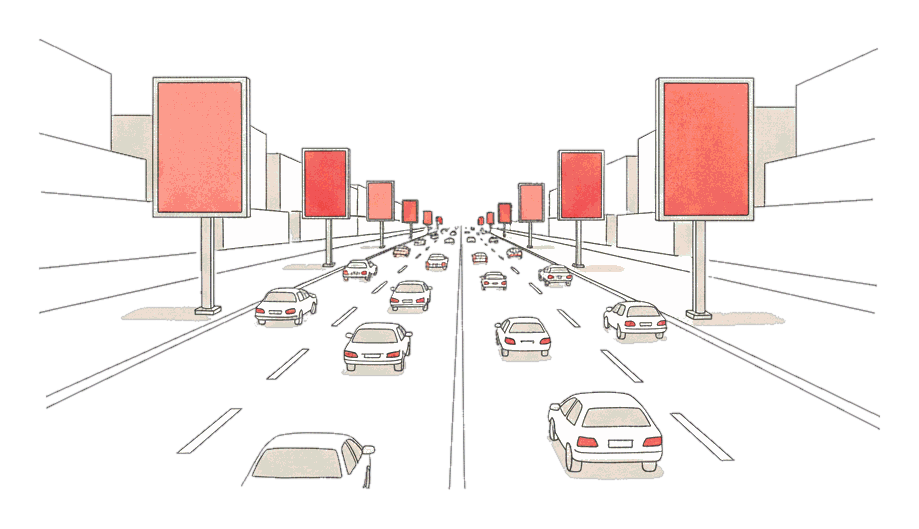
Open the map and pick the screens on the routes people actually commute on: the arteries into downtown, the transit lines and platforms, and the approaches to big stations. Those screens see the same faces on the way out and the way home, which is what builds recall.
On each screen, set the schedule to the morning peak, roughly 7 to 9am, and the evening peak, roughly 5 to 7pm, and leave the empty hours off. You buy the two windows that carry your audience, per screen, by the hour. The hourly scheduling guide goes deeper on this control.
Optionally attach a live trigger so the right creative runs at the right moment, for example show a wet-weather message only when it is raining on that corridor. Weather, temperature, air quality, stock and crypto prices, live scores and a custom live-data API are all supported.
Track the campaign on verified plays, the appearances that actually ran, and on foot-traffic lift, so you can see the peaks working. Blindspot has measured incremental store visits at about $0.82 each.
That is the entire play. You are not managing a wholesale package or waiting on a planner; you are choosing a place and two hours and reading the price. If you want a starting draft, describe the audience and city to Blinky and refine what it gives you.
Which hours to buy, and which to skip
A daypart is a block of hours with its own crowd. Buying by the hour means paying for the blocks that carry your audience and dropping the rest. Here is how the day breaks down for a commuter campaign, and when each block is worth the money.
| Daypart | Who is out | Per-play vs all-day | When to buy it |
|---|---|---|---|
| Morning peak, 7-9am | Commuters heading to work, school runs | Premium, ~1.5x to 2x on transit | Yes, a core window |
| Midday, 12-2pm | Lunch crowds, errands, shoppers | Near the off-peak rate | Optional, for lunch and errand audiences |
| Evening peak, 5-7pm | The commute home, after-work crowds | Premium, often the priciest | Yes, usually the strongest window |
| Late evening | Nightlife, diners, leisure | Off-peak to a mild premium in nightlife zones | Only for nightlife or leisure ads |
| Overnight | Almost nobody | Off-peak, but near-zero audience | Skip it |
Peak plays cost a premium, roughly 1.5 to 2 times the off-peak rate on busy transit, and can run higher on the busiest lines. That is expected: the premium buys you the audience rather than silence. The point of buying by the hour is not to chase the cheapest play, it is to concentrate the budget where the people are. Actual prices vary by screen and city and are shown before you book. See billboard costs for the format-by-format picture.
Two peaks vs an all-day flight
Take one transit screen on a commuter corridor. Rented all day, an all-hours flight pays the same rate for the 3am concourse and the empty mid-morning as it does for the evening rush, and most of that spend lands in hours that convert poorly. Now buy the same screen for the two peaks only, the morning 7 to 9am and the evening 5 to 7pm. You keep every useful play and drop the dead hours entirely.
7am
the morning peak starts
30%+
of a rush-hour buy's waste removed by hourly scheduling
48h
to live after screen-owner approval
2x
typical peak-hour premium ceiling
Across a real plan, cutting those empty hours typically removes 30% or more of the budget without losing a single peak-hour appearance, and the freed money buys more plays inside the windows that matter. Peak plays do cost a premium, roughly 1.5 to 2 times the off-peak rate on busy transit, but you are trading a discount you would never use, on hours nobody is watching, for repetition in the hours your audience is on the street.
This is the same mechanism that let a worldwide tourism campaign on Blindspot deliver 87% more plays than planned, by concentrating delivery into peak windows instead of paying for empty ones. In that campaign the evening turned out to be the strongest window, which is the pattern for many commuter audiences: people are less rushed on the way home and spend longer in front of a screen. You do not have to guess the split in advance; you set the two windows, watch the verified plays, and shift weight toward whichever peak performs.
Commuter corridors, city by city
A commuter corridor is any route the same people travel twice a day: the arterial road into downtown, the transit line and its platforms, the ring road, the approaches to a major station. Those screens catch the morning outbound and the evening return, so a two-peak schedule reaches the same audience with repetition, which is what moves recall. Every city has its own corridors and its own rhythm, and the map shows you which screens sit on them.
Pick your market and study its arteries: the bridges and avenues in New York, the freeways and surface streets in Los Angeles, the L lines and expressways in Chicago, the Underground and arterial roads in London, the BART approaches and downtown grid in San Francisco, and the I-35 corridor and central districts in Austin. Each city page shows the live screens and their per-play prices, so you can see the corridors before you plan.
You are not limited to one city. Because the schedule is set per screen, a single plan can run the morning and evening peaks across several markets at once, each on its own local rhythm, on one map and one invoice. Open the full map to find the corridors in any city, or let Blinky propose the screens for a target audience.
Buy the two peaks, not the day.
The rush-hour play, in one line