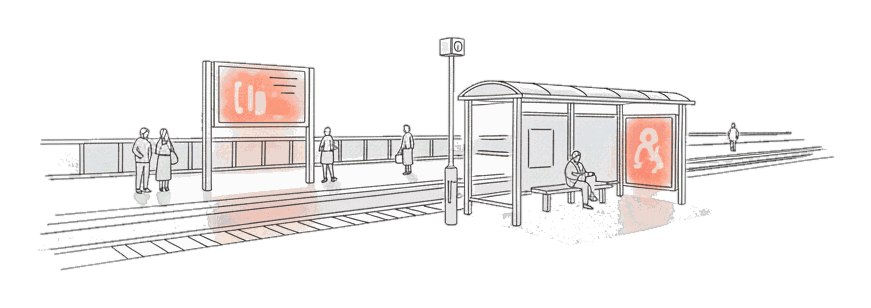
What transit advertising is, and who it reaches
Transit advertising is out-of-home advertising placed where people move through a city on their way to and from work: on rail and metro platforms, inside bus shelters, across the concourses of big stations, and on the exteriors of buses and trains. Digital transit advertising, or transit DOOH, runs that placement on screens rather than paper, so the message can change by the hour and react to live conditions. It is one of the oldest and most reliable ad environments there is, because a commute is a fixed, repeated habit: the same people pass the same screens at the same times, five days a week.
What separates transit from a highway billboard is dwell. A driver sees a roadside board for a second or two. A commuter waiting for the 8:10 train, or sitting in a shelter as three buses go by, has minutes of unhurried attention and very little to do with them. That is the format's real advantage: time on the screen. It suits a message that needs more than a logo, a launch that needs an explanation, a QR code that someone can actually scan, a brand that wants to be part of the everyday backdrop of a working week.
The audience is broad but predictable. Rail and metro platforms skew toward professionals and daily office commuters. Bus shelters and street-level panels reach a wider street mix, pedestrians, shoppers and riders together. Station concourses in a major hub concentrate enormous foot traffic into a small footprint, including weekend and intercity travellers. Because Blindspot prices every screen per play and shows live availability, you can pick the exact places and audiences you want and see what each one costs before committing a cent. This guide covers the formats, why buying the commuter peaks saves so much, how to build a transit plan on the map, and how live triggers take timing past the clock.
The transit formats, side by side
Transit is not one screen, it is a family of placements with different audiences, dwell profiles and peak windows. The table below is how to think about them when you build a plan. Every one is booked the same way on Blindspot: by the hour, priced per play, with the price shown before you book.
| Format | Audience | Peak windows | Per-play framing |
|---|---|---|---|
| Rail & metro platform | Commuters waiting, high dwell | 7 to 9am, 5 to 7pm weekdays | Per play from about $0.23 on urban panels |
| Bus shelter | Waiting riders plus street pedestrians | Morning and evening commute, lunch | Per play, booked by the hour |
| Station concourse | Dense foot traffic through a hub | All commute peaks, plus weekend travel | Per play, price shown before booking |
| Bus & rail exterior | Moving street audiences on a route | Commute plus shopping hours | Per play, targeted by route and zone |
A simple way to choose: platforms and shelters for a high-dwell message a commuter can read and act on, concourses for raw reach in a busy hub, exteriors for repetition along a route. Most transit plans mix two or three, each dayparted to its own peak. Browse what is live near you on the screen map, or compare the wider network in the DOOH platforms guide.
Why buying commuter peaks cuts the cost
3,000,000+
transit, street and station screens, 50+ countries
$0.23
per play, urban-panel floor
30%+
of a buy's waste removed
48
hours to live
A commute is peaked, not flat. Almost everyone who uses a transit screen uses it in two tight windows: the morning rush and the evening rush, with a smaller lunch bump. Overnight, and through the deep midday lull, a platform or shelter screen plays to an almost empty station. The traditional way of buying transit, a fixed flight that rents the screen for every hour of every day, pays the same rate for the 3am empty platform as for the 8am crush. Those dead hours are pure waste: the plays run, the money leaves, and almost no commuter is there to see the ad.
Hourly buying removes them. On Blindspot you set a schedule for each transit screen on a 7-day by 24-hour grid and buy only the windows that carry your audience: the morning and evening commute on a rail platform, the commute plus lunch on a busy shelter, the all-day peaks on a hub concourse. The overnight and the dead midday hours simply go dark, and you pay nothing for them. Because a standard urban panel runs about $0.23 a play, and roughly a third of an around-the-clock flight is low-traffic time, cutting those hours removes about 30% of the plays and about 30% of the spend without losing a single useful appearance. The freed budget then buys more plays in the windows that convert.
This is the point that matters most, and it is not a small-budget trick: it is maximum efficiency at any size. A first campaign on a few shelter screens spends only on the two-hour windows a commuter is present, so a modest budget buys the real exposure it needs rather than filler plays. A worldwide flight does the same thing thousands of times over. On a global tourism campaign, Blindspot ran 4,067 screens and reached more than 97 million people over 51 days, and by concentrating delivery into peak windows the campaign delivered 2,146,892 plays, 87% more than planned, with the evening as the strongest window. The full breakdown is in the Visit Maharashtra case study. The mechanism is the same on a single bus shelter: put the plays where the commuters are, and stop paying for the hours when they are not. There is no minimum spend, so the efficiency is available whether you start with one screen or a thousand.
How to buy transit DOOH on Blindspot
Buying transit advertising on Blindspot is fully self-serve, so there is no media buyer and no sales call in the middle. You open the map, filter for transit formats, and every rail platform, shelter and concourse screen shows its per-play price and live availability. You pick the ones you want, in the neighbourhoods and hubs your audience passes, and add them to a plan.
Then you set the hours. Each screen you pick gets its own hourly grid, so you paint the commute windows onto a rail platform, the lunch and evening onto a shelter, the all-day peaks onto a concourse, and set how many times each screen plays in each hour, its plays-per-hour, so a rush-hour slot can run harder than a quiet one. The running cost updates as you paint, so you always see what the plan costs before you commit. Upload a creative, and the campaign goes to the screen operators for approval, which takes roughly two business days, then goes live in about 48 hours.
If you would rather not build the grid by hand across dozens of transit screens, Blinky, the free agentic AI planner, will read a one-line brief and propose a schedule per screen for you, weighting each one toward its own commuter peak, which you can then adjust cell by cell. Blinky reads from more than 7 million data points on how audiences move through a place, so its first transit draft already knows when a given platform is busy. When you are ready, walk through the full flow in the book a billboard guide, or start from the screen map.
Past the clock: live triggers on transit
Hours are the base layer of transit timing, but the commute does not always follow the clock. A rain jacket wants the rain, and a shelter is exactly where a wet commuter is standing. A cold-and-flu brand wants the cold snap. A stadium concourse wants the match. On top of the hourly schedule, Blindspot lets a creative fire on live conditions, so a transit screen can be booked for the commute window and still only show a given ad when the world matches.
The live triggers available today include weather and temperature, air quality (AQI), stock and crypto prices, live sports scores, and a custom live-data API for anything you can feed it. You set the rule once, for example run the umbrella creative on shelter screens only when it is raining, and the platform swaps the message in and out as conditions change, inside the commute hours you already scheduled. It is dayparting extended from the clock to the street.
Layered together, the two give tight control over when and where a transit message appears: the hourly grid decides the commute windows, the plays-per-hour decides the weight, and the triggers decide the moment. See how it comes together in the rush-hour playbook and the hourly scheduling guide, or browse screens and start building.
Pay for the commuter peaks, not the empty hours between them.
Transit advertising, in one line