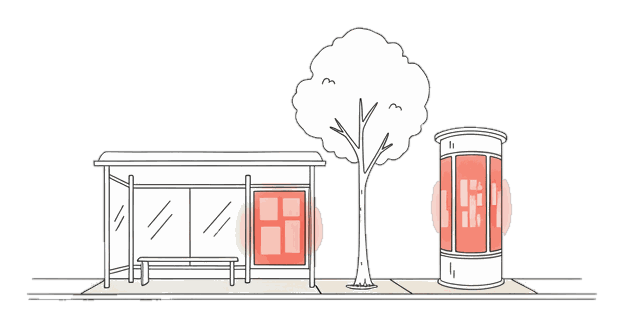
What street furniture DOOH is
Street furniture is the trade name for the fixtures a city puts on its pavements: bus and tram shelters, freestanding information kiosks, sidewalk pillars and totems, the panels at a stop where you wait for a ride. Advertising has lived on these surfaces for decades as printed posters. The digital version, street furniture DOOH, swaps the paper for a screen, and that one change turns a static poster into an ad you can book by the hour, price per play, and switch on live conditions.
What sets the format apart is where it sits. A billboard aims at traffic from a distance, usually above a road, read in a glance at speed. A street furniture screen sits at eye level, an arm's length from the sidewalk, in front of people who are walking, waiting or shopping. That closeness is the whole point: the message meets a person, not a windscreen, in the heart of a neighborhood. It is the most local, most pedestrian DOOH format there is, and it reaches the moment people slow down, at a stop, at a corner, outside a shop.
The unit underneath every one of these screens on Blindspot is the play: one ad appearance on one screen, with the per-play price shown on the screen card before you book. From there you decide when the plays happen and how many run per hour. There is no minimum spend and no agency in the middle, so a plan can be a single shelter running a two-hour window or thousands of panels dayparted across cities. This guide covers the formats, how to target them down to a few blocks, why the model spends a budget efficiently at any size, and how to build a street furniture plan yourself.
The formats, side by side
Street furniture is not one screen but a family of them, and each one meets a slightly different audience at a different time. A bus shelter panel reaches waiting riders and passing pedestrians with real dwell, because people at a stop are stationary and looking around. A freestanding kiosk sits in the flow of a busy sidewalk or square and reaches people on the move. A pillar or totem anchors a corner or an entrance and works as a landmark. The table sets out who each reaches, when they peak, and how the per-play model frames the buy.
| Format | Audience | Peak windows | Per-play framing |
|---|---|---|---|
| Bus shelter | Waiting riders and passing walkers, real dwell at the stop | Morning and evening commute | Book the commute hours only, per play from $0.23 |
| Sidewalk kiosk | Pedestrians in the flow of a busy street or square | Lunchtime and after-work | Weight plays-per-hour to the busiest windows |
| Pillar / totem | Shoppers and pedestrians at a corner or retail entrance | Retail hours, evening for nightlife strips | Buy the open-for-business window, drop the overnight |
Peak windows are typical patterns, not fixed rules; the point of hourly booking is that you set each screen to its own local rhythm. A shelter outside a stadium peaks on event nights, a kiosk in a business district peaks at lunch, a totem on a nightlife strip peaks late. On Blindspot the per-play price and live availability for each panel show before you book, so you can see the cost of a plan as you build it. Compare the wider field in the DOOH platforms guide, or start from the screen map.
The specification a creative needs is simple, and the platform surfaces it on every screen so nothing runs off spec. A street furniture panel is usually portrait, bright enough to read in daylight, and built for a short, single-message glance rather than a wall of copy. The key numbers are on the screen card.
Neighborhood and hyperlocal targeting
Because street furniture sits on the sidewalk, it is the format that rewards tight, hyperlocal targeting the most. A billboard is bought for a whole corridor; a shelter is bought for a block. On Blindspot you pick screens on a map, so you can draw a plan around the streets that matter: the few shelters outside a new store, the kiosks along a cafe strip, the panels ringing a stadium on a match day, the totems at the entrances to a shopping district. You are not buying a market, you are buying the pavements your audience actually uses.
That control extends to time as well as place. Every screen carries its own schedule on a 7-day by 24-hour grid, so a shelter by an office can run the morning commute while a kiosk near restaurants two streets over runs the lunch and dinner windows, on the same campaign. Each screen also gets its own plays-per-hour, so a busy corner can run heavier than a quiet one. The result is a plan that follows the neighborhood's rhythm rather than a flat, all-day rental, and it is why street furniture pairs so naturally with the hourly scheduling model.
Timing can go past the clock, too. On top of the hourly grid, a creative can fire on live conditions: run the hot-drink message on a cold morning, the rain creative when it rains, the event creative when a score changes. The live triggers available today include weather and temperature, air quality, stock and crypto prices, live sports scores, and a custom live-data feed for anything else. You set the rule once and the platform swaps the message in and out inside the hours you already scheduled. The weather-triggered guide covers how that works on the same panels.
If building all of that screen by screen sounds like work, it does not have to be. Blinky, the free AI planner, reads a one-line brief and proposes which street furniture screens to book and how to schedule each one, drawing on more than 7 million data points about how audiences move through a place. You get a first draft weighted toward each panel's own peak, and you adjust it cell by cell before you publish.
Efficiency at any budget
3,000,000+
screens, 50+ countries
$0.23
from, per play in an urban market
30%+
of a buy's waste removed by hourly buying
48
hours to live after approval
The reason to buy street furniture per play, by the hour, is efficiency, and it works the same way whether the budget is a few hundred dollars or a global flight. A traditional shelter poster is a fixed multi-week rental: you pay the same for the 3am empty stop as for the evening rush, and the dead hours are pure waste. Per-play hourly buying removes them. You book the windows when the street is busy and drop the ones when it is empty, so the budget spends on real exposure instead of filler plays. Buying only the busy hours typically takes 30% or more of the waste out of a buy, and the freed budget buys more plays in the windows that convert.
This is not only a small-budget tactic. On a worldwide tourism campaign, Blindspot ran 4,067 screens and reached more than 97 million people over 51 days, and by concentrating delivery into the peak windows the campaign delivered 2,146,892 plays, 87% more than planned, with the evening as the strongest window. That is the same mechanism a single-shelter buyer uses, scaled up: put the plays where the people are, and stop paying for the hours when they are not. The full breakdown is in the Visit Maharashtra case study.
There is no minimum spend, which matters for a format this local. If all you need is three shelters around a store opening for a weekend, that is a real plan; if you need street furniture in twenty cities, that is the same flow with more pins on the map. Either way the budget buys the exposure it actually needs, so it works as hard on a first campaign as on a national one. That efficiency, not a low headline price, is the point.
A shelter is bought for a block, not a corridor.
Street furniture, in one line
How to buy street furniture on Blindspot
Buying a street furniture plan is fully self-serve, so none of it needs a media buyer or a sales call. Open the map and filter for street furniture: the bus shelters, kiosks and pillars in the area you care about. Each screen shows its format, its live availability, and its per-play price, so you can see exactly what you are booking before you commit. Pick the panels you want, the same way you would drop pins on the streets that matter.
Next, set the hours. Paint the windows you want each screen to run on its 7-day by 24-hour grid, and set its plays-per-hour so the busy panels run harder than the quiet ones. The running cost updates as you paint, so the budget is never a surprise. Add your creative, built for a portrait, single-message glance, and, if you want it, set a live trigger so a message only shows when the world matches. Then publish.
Every screen is approved by its operator, which takes roughly two business days, and campaigns go live in about 48 hours. From there you watch verified plays come in, screen by screen, and read the delivery against your plan. If you would rather start from a brief than a blank map, Blinky will draft the whole street furniture plan for you to adjust. When you are ready, start booking or browse the screens, and pair street furniture with transit screens or mall and retail screens when a campaign wants both local depth and wider reach.