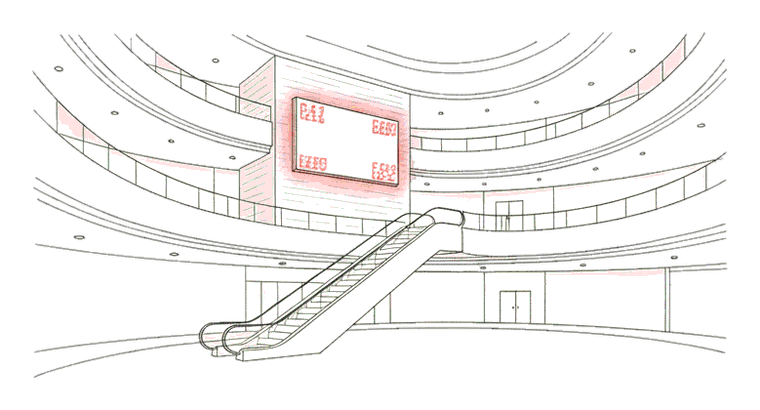
What mall and retail DOOH is
Mall and retail digital out-of-home is advertising on the screens people pass while they shop: the tall panels in a mall atrium, the displays lining a concourse between stores, the walls above a food court, the vertical screens set into a shop window. It is out-of-home, but placed inside a buying environment rather than on a roadside, so it reaches an audience that is already out to spend. The value is proximity. A highway billboard reaches a driver who might buy something tomorrow; a mall screen reaches a shopper who is minutes from a shelf, wallet in hand, deciding right now.
The people it reaches are, by definition, shoppers. They arrived to browse, compare and buy, and they move through a shopping centre in a predictable rhythm: a build through the morning, a peak around lunch and the after-work hours, a long weekend crest. Because they are stationary or slow-moving for much of that trip, dwell time is high, so a screen has more than the two-second glance a moving car gives it. A shopper waiting for a coffee, riding an escalator, or sitting in a food court will read a full message, watch a short piece of motion, and often act on it before they leave the building. That closeness to the purchase is what separates retail DOOH from the rest of out-of-home.
Underneath, the unit is the play: one ad appearance on one screen. The per-play price is shown on every screen card before you book, and a schedule simply decides when those plays happen. There is no minimum spend and no agency in the middle, so a plan can be a single food-court screen running a two-hour lunch window, or thousands of retail screens across a country, each timed to its own centre's trading day. This guide covers where the screens sit and who each placement reaches, how to measure the store visits they drive, why hourly buying keeps any budget efficient, and how to book them yourself on Blindspot. If you want the wider picture first, the what is DOOH guide explains the format, and Blinky, the free AI planner, will draft a mall plan from a one-line brief.
A guide to mall and retail screen placements
A shopping centre is not one audience but several, moving through different spaces at different times, and each placement reaches a different moment of the trip. The best mall campaigns pick placements to a goal rather than buying whatever is available, and because Blindspot schedules every screen individually, you can run all of these in a single plan and give each its own hours. The table below is the practical shorthand.
| Placement | Audience | Best for | Per-play framing |
|---|---|---|---|
| Atrium & entrance | Everyone arriving, high dwell at the threshold | Launches, broad reach, the first impression | Premium panels; book the busy hours; urban floors from about $0.23 |
| Concourse & walkway | Shoppers mid-trip, moving between stores | Category and retailer messages near the shelf | Steady footfall; buy the trading hours per screen |
| Food court & seating | Long-dwell diners, families, groups | Storytelling, QSR and app offers, longer creative | Highest dwell; weight the plays into the meal windows |
| Storefront & window | Buyers at the door, ready to enter | Direct response, promotions, in-store-now messages | Closest to the purchase; buy the opening hours |
| Car park & lift lobby | Arriving and departing shoppers | Reminders, loyalty, return visits | Bookend the trip; light weight, cheaper plays |
Prices are per play and vary by market and screen; the floor of about $0.23 reflects an urban panel, and premium atrium or landmark screens cost more. Availability and exact pricing show live on each screen card. See how per-play pricing works in the billboard cost guide, or browse screens and filter to retail venues.
Atrium and entrance screens are the front door of the centre. Everyone who enters passes them, and there is a natural pause at the threshold as people orient themselves, so dwell is high and reach is at its widest. These are the placements for a brand launch or a campaign that needs to be seen by the whole footfall, and they are usually the most premium screens in the building. Concourse and walkway screens catch shoppers already in motion, walking a specific route past specific stores. That is the placement for a category message or a retailer takeover, because the shopper is seconds from the aisle the ad is about.
Food-court screens are the sleeper. A food court holds people for fifteen or twenty minutes, seated, relaxed and looking around, which is the longest voluntary dwell in the whole centre. That makes it the one mall placement where a longer, story-led creative actually gets watched, and where a quick-service restaurant offer or an app download prompt lands on a captive audience. Storefront and window screens are the last placement before the purchase, aimed at a shopper standing at the door, so they carry direct-response messages: a promotion, a new arrival, a reason to walk in now. Car-park and lift-lobby screens bookend the trip, reaching people on the way in with a reminder and on the way out with a loyalty or return-visit prompt. Layer a few of these and one campaign speaks to the shopper at arrival, mid-trip and at the shelf.
Measuring foot traffic near the point of purchase
The old knock on out-of-home was that you could not prove it worked. Retail DOOH is where that objection is weakest, because the distance between seeing the ad and acting on it is so short. The shopper who reads a screen in the atrium can be in the store two minutes later, so the walk from message to till is measurable in a way a roadside billboard's is not. Blindspot is built to measure exactly that.
It starts with the receipt. Every play is logged as verified proof-of-play: which screen ran the ad, at what time, in what place. That log is the ground truth behind everything else, because you are measuring against real appearances, not a forecast. On top of it, Blindspot reads the foot-traffic and web lift that follows a campaign against a control group, so you can separate the visits your screens drove from the visits that would have happened anyway. Across measured campaigns those outcomes have come out around $0.82 per incremental store visit, $0.80 per incremental web visit, and $5.75 per incremental online purchase, well under the $15 to $40 that a typical paid-social acquisition tends to cost. The full mechanics, and how the control-group math works, are in the billboard attribution guide for D2C brands.
The results in a mall setting can be dramatic, because the audience is already primed to buy. Intimissimi ran DOOH close to its stores and read a 53% lift in store visits; Pepsi drove a 168% lift in in-store sales by timing screens to the moments shoppers were deciding what to pick up. Adore Me used the same closeness to turn screen exposure into measured web and store traffic. The pattern across them is the same: put the message where the buyer already is, log every play, and measure the visits, so the campaign reports in the language a growth team actually uses, cost per visit and cost per purchase, rather than a soft impression count. Those stories are collected in the case studies.
The walk from screen to store is a two-minute round trip.
Retail DOOH, in one line
Efficiency at any budget
3,000,000+
screens, 50+ countries
$0.23
urban floor, per play
48
hours to live
30%+
of a buy's waste removed by hourly buying
The point of mall DOOH is not that it is cheap; it is that a budget of any size spends only on the real exposure it needs. A shopping centre is closed overnight and quiet for long stretches of the day, and a traditional four-week flight pays the same rate for an empty 7am concourse as for a Saturday-afternoon crush. Those dead hours are pure waste: the plays run, the money leaves, and almost no one is there. Hourly buying removes them. On Blindspot each screen carries its own 7-day by 24-hour grid, so you paint in the hours the centre is trading, weight the plays into the peak windows, and leave the closed and quiet hours dark. Dropping the hours nobody is shopping typically removes 30% or more of the waste a full flight would carry, and the freed budget buys more plays when the aisles are full. How the grid works in detail is in the hourly scheduling guide.
That efficiency is what lets the same platform work on a first campaign and on a global flight. A local shop with a few hundred dollars can put a single storefront screen on its two busiest hours and pay for nothing else; a national retailer can run thousands of screens, each timed to its own centre's rhythm, and still spend only where the footfall is. The proof at the large end is Visit Maharashtra, which ran 4,067 screens across 20 cities in 15 countries and reached more than 97 million people over 51 days. By concentrating delivery into the peak windows the campaign delivered 2,146,892 verified plays, 87% more than planned, and ran on all 51 of 51 days, with the evening as its strongest window. The full breakdown is in the Visit Maharashtra case study. Big or small, the rule is the same: put the plays where the shoppers are, and stop paying for the hours they are not.
One quiet note on access: there is no minimum spend and no contract, so the efficiency is open to a small business, not reserved for a national budget. You are never buying a bundle you do not need. That matters most in retail, where a single well-placed screen in a busy centre can drive more measured visits than a scattered roadside buy several times its size.
How to buy mall screens on Blindspot
You buy mall and retail DOOH the same way you would book anything else on Blindspot: yourself, on the map, with no agency and no sales call. Open the platform, filter the screens to retail and shopping-centre venues, and the screens near the centres you care about appear with their per-play price and live availability. You pick the ones you want, set an hourly schedule for each, add your creative, and publish. The running cost updates as you build, so you always see what a plan costs before you commit to it.
The schedule is where a mall plan earns its keep. Give the food-court screen the lunch and dinner windows, the atrium screen the after-work crush and the weekend, the storefront panel the store's own opening hours. Each screen runs its own rhythm, and if you would rather not build the grid by hand, Blinky, the free agentic planner, reads a one-line brief against more than 7 million data points on how audiences move through a place and drafts a per-screen schedule you can then adjust cell by cell. On top of the hours, you can set a creative to fire on live conditions, so a hot-drink promotion runs a cold-weather version and a warm-weather one automatically; the weather-triggered advertising guide covers those rules.
Once you publish, each screen is approved by its operator, which takes roughly two business days, and the campaign goes live in about 48 hours. From there the plays log as they run, the foot-traffic and web lift build, and you watch the campaign report against your control group in real time. To start, see how booking works, browse screens and filter to retail venues, or compare the field first in the best DOOH platforms guide. When you are ready, pick a busy centre, buy its trading hours, and measure the shoppers who walk in.