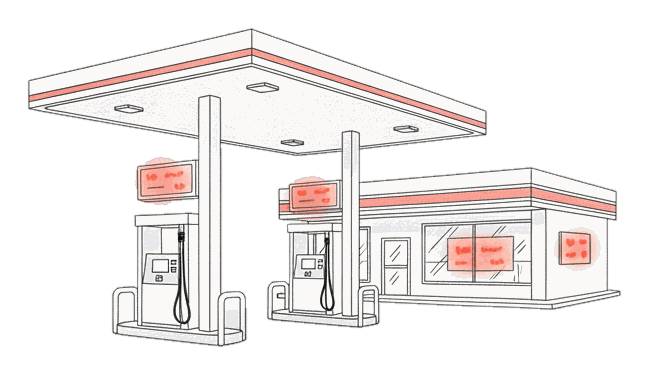
What gas station DOOH is, and the captive-dwell advantage
Gas station DOOH advertising is digital out-of-home built around one unusual fact: a person buying fuel is trapped in place for several minutes. Fuelling a car takes roughly three to five minutes, and for almost all of it the driver is standing at the pump, holding a nozzle, watching the litres tick up, with nothing else to look at. Put a screen on the pump topper, at eye level, and you have a viewer who is both stationary and paying a kind of idle attention that a roadside billboard never gets. A car passes a highway billboard in a second or two; a person at the pump has minutes.
That is the difference the venue trades on. The unit underneath is the same as any other digital out-of-home buy, the play, one ad appearance on one screen, and on Blindspot the per-play price is shown on every screen card before you book. What the forecourt adds is dwell and repetition: the same person often sees the ad several times as it loops during the fill, then again on the walk to and from the convenience store. Few DOOH environments combine a captive body, a screen at reading distance, and a few unhurried minutes the way a fuel forecourt does.
The forecourt is also a decision point. The station is a shop as much as a fuel stop, and the driver is about to walk into the convenience store where drinks, snacks, coffee and impulse items are sold. A message on the pump can land at the exact moment a purchase is being decided, for something inside the store or somewhere just down the road. This guide covers where the screens sit, which brands the environment suits, how the timing works, and how you buy gas station screens by the hour on Blindspot, at any budget, small or large.
Where the screens sit on a forecourt
A fuel station is not one screen but several placements, each with its own audience, dwell and best use. Understanding the differences is what lets you buy the right ones rather than the whole site. The table below sets out the main placements and how they are framed on a per-play buy.
| Placement | Audience | Dwell | Per-play framing |
|---|---|---|---|
| Pump topper | The driver refuelling, standing still at eye level | 3-5 min, captive | Longest dwell, per play from $0.23 |
| Forecourt totem | Arriving and departing traffic, passers-by on the lot | 1-3 min, moving | Reach on entry, per play, hourly |
| C-store window / interior | Shoppers at the point of purchase | 30 sec-2 min | Point of sale, per play, hourly |
| Car-wash queue | Waiting drivers, high patience | 3-8 min, captive | Long attentive dwell, per play |
Per-play prices vary by market and traffic; the $0.23 figure is the urban-panel floor, shown on each screen card before you book. The best-attention placements are the pump topper and the car-wash queue, where the viewer is stationary and has minutes to spare. The forecourt totem trades dwell for reach, catching every vehicle that enters the lot. See real prices in the billboard cost guide.
In practice most campaigns mix placements to match a goal. A convenience-store promotion leans on pump toppers and the interior window, because the viewer is minutes and metres from the shelf. A brand-awareness flight for a drink or an app can add the forecourt totem for the extra reach of every car that pulls in. A car-care or insurance message does well at the pump and the wash, where the driver is already thinking about the vehicle. Because each screen is booked individually, you are never forced to take a placement that does not fit; you pick the exact screens you want on the map and pay per play for those only.
Which brands fit, and how to daypart the forecourt
The forecourt suits any message a driver decides on impulse or plans on the road. Convenience-store snacks, drinks and coffee sit inches from the screen. Quick-service food nearby catches a hungry driver at the right moment. Car care, fuel loyalty and insurance meet a person already focused on the vehicle. Road-trip and travel brands, apps with a quick sign-up, and local businesses on the route all fit the few captive seconds the venue gives. The one rule is that the message has to land in a glance or two, because even a captive viewer is only half-watching; big type, one idea, a clear next step.
Timing matters as much as placement, because a fuel station is a different place at different hours. Commuter stations on arterial roads peak twice a day, at the morning and evening rush, when tanks are topped up on the way to and from work. Stations near a route out of the city fill up on Friday afternoons and weekend mornings, when road trips begin. A highway service station runs all day but leans toward daytime long-distance traffic. Buying every hour on every station pays for a lot of empty overnight time; matching hours to the station is where the budget starts working harder.
This is why Blindspot schedules each screen on its own 7-day by 24-hour grid rather than renting a site around the clock. You can run a set of commuter forecourts on the morning and evening peaks only, add weekend daytime on the road-trip stations, and leave the overnight hours dark on all of them. Each screen also carries its own plays-per-hour, so a busy rush-hour slot can run harder than a quiet mid-afternoon one. The result is a single campaign where a downtown forecourt, a highway service station and a suburban c-store each follow their own rhythm. The mechanics are covered in the hourly scheduling guide, and the commute-timing playbook in rush-hour advertising.
Timing can also go past the clock. On top of the hourly schedule, a creative can fire on live conditions, so a cold-drink message shows only when the temperature is above a set point, exactly where a thirsty driver has just parked. The live triggers include weather and temperature, air quality, stock and crypto prices, live sports scores, and a custom live-data feed. See the weather-triggered advertising guide for how conditions are set once and swapped in and out automatically.
Efficiency at any budget, small or large
3,000,000+
screens, 50+ countries
$0.23
per play, urban floor
48
hours to live
30%+
of a buy's waste removed
Blindspot is built for maximum budget efficiency at any size, and the forecourt is a clean example of why. Because pricing is per play and you book by the hour, the budget buys the real exposure it needs and nothing else. A first campaign can be a handful of forecourts in one town, running commute hours only, and spending on those windows alone. The same platform, the same map, the same per-play pricing runs a national forecourt flight of thousands of stations for a large brand. Neither is treated as a lesser buy; both spend only where and when the audience is present.
The biggest hidden cost in a traditional site rental is the hours nobody is there. A station that is quiet from midnight to five still charges for those plays on a full flight: the ad runs, the money leaves, and almost no one sees it. Buying by the hour removes that waste, typically 30% or more of a full-flight buy, and the freed budget buys more plays in the windows that convert. How much you save scales with how peaked your traffic is: a set of commuter stations saves more than an all-day highway stop, because more of its day is dead time.
The efficiency holds on a national flight too, which is the point. On a worldwide tourism campaign, Blindspot ran 4,067 screens across 20 cities in 15 countries and reached more than 97 million people over 51 days. By concentrating delivery into peak windows, the campaign delivered 2,146,892 verified plays, 87% more than planned, with the evening as the strongest window. The full breakdown is in the Visit Maharashtra case study. A forecourt flight uses the same mechanism at whatever size you run it: put the plays where the drivers are, and stop paying for the hours when they are not. When the goal is footfall or online action, delivery can be tied to outcomes; the measurement side is covered in DOOH attribution.
How to buy gas station screens on Blindspot
Buying is fully self-serve, with no media buyer and no sales call. You open the map, filter to forecourt and convenience-store screens in the markets you want, and each screen shows its per-play price and live availability. You pick the exact pump toppers, totems and c-store screens you want, set the hours on each screen's grid, and the running cost updates as you build. When the plan looks right you publish; each screen is approved by its operator in roughly two business days, and the campaign goes live in about 48 hours.
If you would rather not build the grid by hand across dozens of forecourts, Blinky, the free AI planner, reads a one-line brief and proposes a plan: which stations, which hours, and a starting plays-per-hour for each, drawn from more than 7 million data points on how audiences move through a place. You adjust it screen by screen, then publish. Whether you build it yourself or start from Blinky's draft, the same rule applies: the budget spends on the forecourts and hours that carry your drivers, and skips the rest.
To start, browse the screen map and filter to fuel and convenience venues, or read the full self-serve flow in how to book a billboard. To compare gas station DOOH against transit, mall and other venues, or against other platforms, see the DOOH platforms guide.
A driver at the pump is captive for minutes, not seconds.
Gas station DOOH, in one line