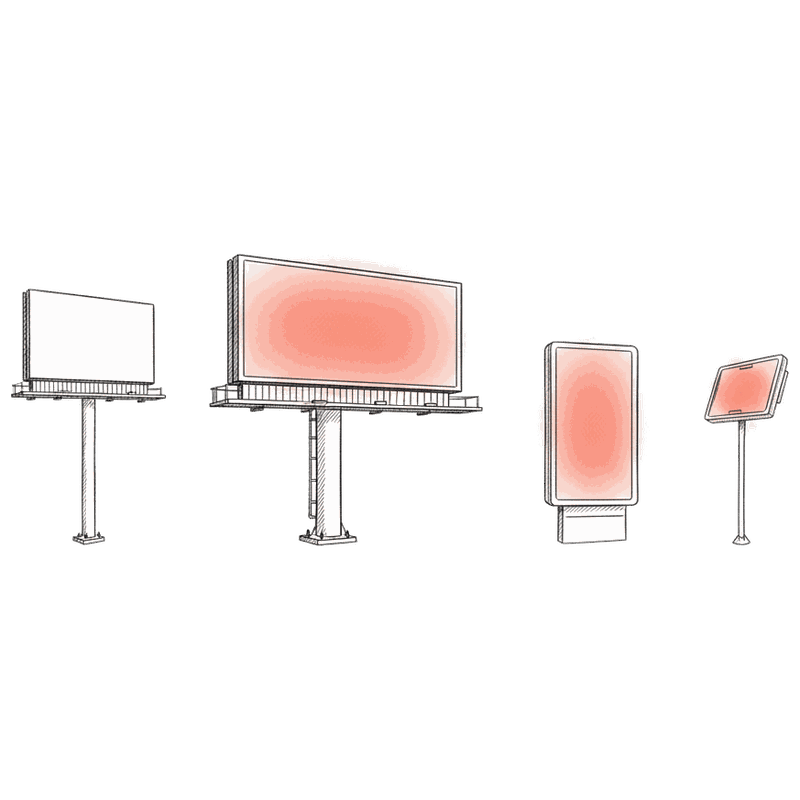
The two families: static and digital
Every billboard, whatever its shape or size, belongs to one of two families. A static billboard is a physical panel, printed vinyl or paper, mounted on a frame. It shows one message for the length of its run, and changing that message means printing a new face and sending a crew to install it. A digital billboard is a screen, LED or LCD, where the message is a file rather than a print job. Swapping the creative takes a click, not a crew, and the same screen can show a different ad at 8am, midday and 9pm.
That single difference is why digital changed the economics of the category. A static panel is sold as a fixed rental: you pay for the panel for a set number of weeks, whether anyone is looking at 3am or not. A digital screen can be sold by the play, one appearance of an ad on one screen, and scheduled by the hour, so you buy the commute and the evening and skip the dead hours entirely. That is the model digital out-of-home (DOOH) runs on, and it is the reason a format that used to require a month-long commitment can now start from $40 with no minimum. For the full comparison of what each family costs and when a static panel still makes sense, see digital versus traditional billboards.
Roadside and highway billboards.
This is the family most people picture first: the large panel on a pole beside a road. Inside it are three distinct formats. A bulletin is the classic large-format roadside billboard, static or digital, aimed at drivers on a highway or a busy arterial road, strongest at the morning and evening commute. A poster is a smaller street-level panel, closer to pedestrians and slower traffic, often at intersections or along a shopping street. A spectacular is the largest and most expensive tier: an oversized digital display at a landmark, high-traffic location such as Times Square, Piccadilly Circus or Shibuya crossing, sometimes wrapping a building corner or combining several screens into one display.
On Blindspot, every roadside format is booked the same way: pick the screen, set the hours, pay per play. A bulletin or poster on an ordinary urban road runs from about $0.23 a play, while a spectacular in a flagship location runs up to around $40 a play, the premium reflecting the location and the audience rather than a different buying model. The full family of digital roadside screens, including how they are built and priced, is covered in the outdoor LED billboard guide, and live per-play prices by city sit in the DOOH price index. Roadside formats look different market to market too; the digital billboards in Italy guide is one example of how the same formats show up locally.
Transit and street furniture
These are the formats built into the street itself rather than standing beside it, and they trade size for proximity: a pedestrian stands inches away, often with time on their hands. A bus shelter panel is built into the shelter structure at eye level, seen while someone waits. A citylight is a slim, usually backlit vertical panel on a sidewalk, a building front or a pedestrian crossing, sized for a close, walking-pace read. A kiosk is a freestanding piece of street furniture carrying an ad panel, sometimes on more than one face, common in dense city centers and transit plazas.
Because these formats sit so close to the audience, the creative has to work at a glance and often in a narrow vertical frame, so it is worth checking the billboard design guide before you brief a citylight or kiosk creative. Transit and street-furniture screens are part of the wider formats and venues topic, alongside every other placement type covered in this guide, all searchable by venue and photo before you book.
Retail, mall and venue screens
These formats sit closest to the moment someone decides to spend money. A mall screen runs at entrances, along concourses or near an elevator lobby, reaching shoppers between stores. A venue screen sits around a stadium, arena or event space, and its audience spikes with the crowd rather than staying steady through the day, so the hours that matter are the hours around the event, not the clock in general. Both formats reward tight, contextual creative, since the viewer is close, often on foot, and only there for a short window.
You can browse the actual retail and venue screens by city, with their own photo, footfall pattern and per-play price, rather than judging a format in the abstract; open the map and browse screens, or start from the creative topic for how to design for a screen someone passes at close range.
Mobile and taxi-top screens
Every format covered so far stays in one place and waits for the audience to pass. A taxi-top screen does the opposite: a static or digital panel mounted on the roof of a taxi or rideshare car, it moves through a city all day, crossing neighborhoods a fixed billboard never reaches in a single flight. That makes it a useful complement to place-based formats, especially for hyperlocal campaigns, event traffic, or a brand that wants coverage across a whole metro rather than one junction.
Every other format waits. The taxi-top moves to the audience.
Mobile and taxi-top screens, in one line
The dedicated taxi-top advertising guide covers how the format works, what it costs and where it fits alongside roadside, transit and retail formats. On Blindspot, a taxi-top books the same way as any other screen, by the hour, per play, no minimum, so it can run as its own campaign or sit inside a plan alongside fixed screens; see how booking works for the full flow.
Choosing the right format for your budget
2
billboard families: static and digital
$0.23
a play, from, on an urban screen
$40
a play, up to, for a Times Square spectacular
3M+
screens to choose a format from
The honest answer to "which format should I book" is not a budget tier, it is a question about where your audience already is. A nightlife brand does better on transit citylights and taxi-tops in the evening than on a highway bulletin at noon. A retailer does better on a mall screen at lunch than a spectacular at 3am. A product launch might want a highway spectacular for reach and a cluster of transit and retail screens for frequency, running at the same time. The efficiency is in matching the format to the moment, and that holds at any budget, a single screen for a weekend or thousands of screens across a global launch.
Because every format on Blindspot is priced the same way, per play, with no minimum spend, a small budget is not locked out of any format, including a spectacular; it simply buys fewer plays of it. Self-serve campaigns start from $40. Work out the numbers for your plan with how much a billboard costs, compare the static and digital paths again in digital versus traditional billboards, and go deeper on the digital roadside family in the outdoor LED billboard guide. New to booking altogether? Start with your first campaign, compare the field in best DOOH platforms, or let Blinky, the free AI planner, read a one-line brief and propose a format mix and schedule for you.