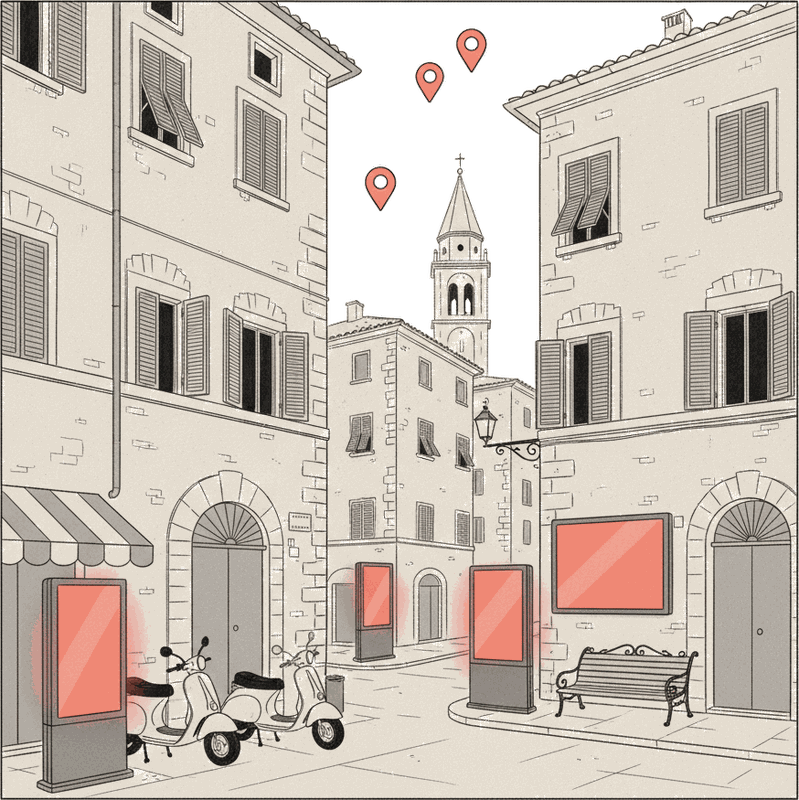
The Italian DOOH landscape
Digital out-of-home is well established across Italy, and it concentrates where the people do. Milan is the business and fashion capital and the densest screen market; Rome carries the government, media and tourist flows of the capital; Naples anchors the south; Turin is the industrial and design hub of the northwest; and Bologna sits at the crossroads of the north with a large student population. Each of these cities has a real digital estate you can advertise on.
The formats are the same ones you would recognise anywhere in Europe: roadside LED and digital billboards on the main arteries, transit screens in and around metro and rail stations, retail and mall screens where people shop, and city-centre citylight panels along the busiest streets. If you are new to the medium, the what is DOOH primer explains how digital out-of-home differs from a painted board. On Blindspot, all of these Italian screen types sit on one map alongside the rest of the global network, so you plan Italy the same way you would plan any market.
That is the point of the platform for a marketer: any budget, one screen in one Italian city or hundreds across five, buys the same way, priced per play and scheduled by the hour, with no minimum and no sales call.
Where the audiences are
Italian cities do not all move to the same clock, and that is what makes hourly scheduling worth using here. Milan runs on a business rhythm: heavy weekday commutes, dense office and retail districts, and events that surge the calendar, so a screen in a Milan business corridor earns its keep in working hours. The historic and tourist cities, Rome, Venice and Florence among them, hold their crowds later into the evening and across the weekend, driven by visitors as much as residents, so an evening or weekend weighting usually beats a flat weekday buy.
The practical takeaway is to match each screen to when its place is actually full. A station screen wants the commute, a shopping-street panel wants the afternoon and early evening, a nightlife-district screen wants the late hours. Because Blindspot schedules every screen on its own grid, one Italy plan can carry all of those rhythms at once. If you want the reasoning behind timing a campaign to when people are out, the planning and buying topic and the first campaign guide walk through it.
What it costs
Italian digital billboards are priced per play on Blindspot: one price for one ad appearance on one screen, shown on the screen card before you book. There is no CPM to translate and no minimum spend to clear. Because it is per play, the cost of a campaign is simply the plays you choose to buy, and hourly scheduling lets you buy fewer, better-placed plays instead of paying for a screen around the clock.
Rates move with city, format and time of day, a premium city-centre screen in central Milan costs more per play than a neighbourhood panel, and a peak evening hour costs more than a quiet overnight one. We will not invent a single Italy price here, because the honest answer is a range you should read from real data. The DOOH advertising costs in Europe 2026 guide breaks prices down by city and format, and the live DOOH price index shows current per-play numbers across markets. For the wider picture of what outdoor advertising costs, see the billboard cost guide.
$40
self-serve minimum to start
3M+
screens worldwide, one map
50+
countries, Italy included
48h
from booking to live
The efficiency is the same everywhere: buying only the hours your audience is out, and dropping the empty overnight and dead midday hours a full flight pays for, typically removes about a third of the waste in a campaign. On Italian screens that means a modest budget can still hold a real presence in Milan or Rome, because the money goes to the windows that carry people, not the hours nobody is watching.
How to buy across Italy on Blindspot
Buying Italian DOOH on Blindspot is self-serve from start to finish. You browse the screens on a map, filter to the Italian cities and formats you want, and add them to a plan. Every screen shows its per-play price and live availability, and one plan can hold screens from several cities at once, so you can build a Milan and Rome campaign in the same basket. Then you set the schedule.
Scheduling is per screen. Each screen gets a 7-day by 24-hour grid, and you paint the hours you want it to run, with its own plays-per-hour. A Milan business-district screen can run weekday mornings while a Rome city-centre screen runs weekend evenings, all inside one campaign. The running cost updates as you paint, so you always see what the plan costs before you commit. The full step-by-step is in the how to book a billboard guide.
If you would rather not build the grid by hand across dozens of Italian screens, Blinky, the free AI planner, reads a one-line brief and drafts a plan for you, weighting each screen toward its own peak, which you can then adjust cell by cell before you publish. Screen types and venues are covered in the formats and venues topic if you want to choose deliberately.
Getting started
You do not need an Italian agency, a media buyer or a sales call to run digital billboards in Italy. Create a free account, open the map, filter to your Italian cities, and start a plan. Pick a couple of screens in the city that matters most, schedule them to the hours your audience is out, and watch the per-play cost as you go. You can start small, one screen in Milan for the morning commute is a valid campaign, and grow from there.
When the plan looks right, publish it. The operator approves the screens in roughly two business days and the campaign goes live in about 48 hours, priced per play with no minimum. From there you can add cities, adjust hours, or let Blinky expand the plan. The whole point is that a small budget planned well can hold a real presence in an Italian city, because it spends on the hours that carry people.
Run one campaign across Italy, each screen on its own clock.
Italian DOOH, in one line