The core difference
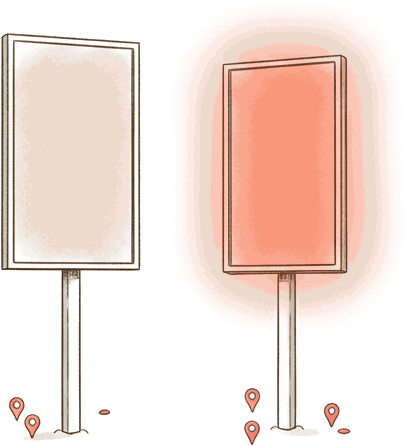
Strip away the marketing and the two formats differ in one word: change. A traditional billboard is a printed sheet. Someone designs the artwork, a printer runs it, and a crew pastes or hangs it on a structure at one site. That single creative stays up, unchanged, for the length of the booking, which is usually a multi-week contract. It is a fixed, physical, always-on presence, and that is both its strength and its limit.
A digital billboard is a screen. The creative is a file, so it can switch in seconds, run different messages at different hours, or react to live conditions like weather or a live score. Nothing is printed, shipped or pasted, so the space is sold by time rather than by a physical run, and priced per play: the cost of one real appearance of your ad on one screen, not a cost per thousand modelled views. That single change, a sheet you print once versus a screen you can rewrite anytime, is what drives every other difference below: how you pay, how flexible you are, what you can target, how it is measured and how fast it goes live. If you are new to the digital side, what is DOOH covers the basics.
Digital vs static, line by line
The dimensions that actually decide the choice. Digital figures are from live Blindspot platform data; the static description is the standard printed out-of-home model most operators run on. Where a comparison is not like-for-like, the row says so.
| Dimension | Digital billboard | Static billboard |
|---|---|---|
| Cost model | Per play, the cost of one ad appearance, from $0.23, shown before you book | A multi-week printed contract, one flat rate for the whole run, plus print and install |
| Minimum | None; self-serve from about $40, no retainer, no platform fee | Larger; a full multi-week booking sets a practical floor well above a lean test |
| Flexibility | Change the creative anytime, run different messages by hour, no reprint | One printed sheet for the whole contract; any change means a fresh print |
| Targeting | By the hour, by location, and by live context (weather, events, time of day) | Fixed: one site, always on, for the length of the contract |
| Measurement | Verified plays logged with a time and a place, plus measured lift | Estimated audience from traffic counts and location models |
| Speed to live | Minutes to plan, live in about 48 hours, nothing to print | Weeks: design, print, ship and install before it runs |
3M+
digital screens on Blindspot
50+
countries covered
$0.52
median cost per play
48h
to live on digital
Digital figures are from live platform data, Q3 2026. The two formats price differently by design: a printed static run is one contract rate, while digital is priced per play, not per thousand. See the full per-format picture in the billboard cost guide and the live price index.
When a static billboard still wins
There are real briefs where a traditional static billboard is the better tool, and it helps nobody to pretend otherwise. Choose static when:
You want a long, always-on presence at one landmark. A printed board at a single high-traffic site, held for months, gives you a constant, unmissable fixture that people pass every day. When the plan is a long-run brand statement at one specific location, and you are not changing the message, a multi-week contract at a flat rate can be genuinely cost-effective, because the per-day cost of a long hold drops the longer you keep it.
You need a print-only or hand-finished creative. Painted walls, hand-finished murals and large printed wallscapes are physical crafts a screen cannot copy. If the idea depends on the texture, scale or artistry of print, a static format is the point, and digital simply is not built for it.
The site itself is the campaign. Some iconic printed placements are famous as objects: a specific wall, a specific roadside board. When the physical site and its permanence are the message, static delivers something a rotating screen does not.
If your brief looks like any of those, a static billboard is a sound choice, and it is fair to say so plainly. Digital is not trying to replace a painted wall or a long landmark hold. It is a different tool for a different job.
When digital wins
For most plans, most of the time, digital is the stronger choice, because the things a screen can do that a printed sheet cannot are exactly the things that make a budget work harder. Choose digital when:
You want flexibility. The creative is a file, so you can change it anytime, run a morning message and an evening one, or swap in a new offer the day it launches, all without reprinting or reinstalling anything. That alone rules out a lot of the waste in a fixed printed run.
You want to target by hour, place and context. Digital is booked by the exact hour per screen, so you can run only the commuter peaks, an evening window or a single event and skip the empty overnight hours a contract still pays for. Cutting those dead hours puts the same budget into the windows that carry your audience. Creative can also react to live conditions: weather, temperature, air quality, stock and crypto moves, live sports scores or a custom live-data feed. Our guide to creative for DOOH covers how that is set up.
You want measurement, not estimates. Delivery is logged as verified plays, each with a time and a place you can audit, rather than a modelled audience. That turns out-of-home into something you can measure and compare, closer to the accountability of digital media than a printed board can offer. See measurement for how plays and lift are tracked.
You want efficiency at any budget. Every screen shows its per-play price before you book, from about $0.23, roughly $0.52 median, with no minimum and self-serve from about $40. A real campaign can start for a few hundred dollars, which makes digital workable for a lean test that a multi-week static contract would rule out, and it makes a large budget go further too. On premium landmark screens (a Times Square play near $40) the raw media rate is set by the operator and is similar in either format, so there the advantage is control and transparency, not a large price gap.
A traditional billboard is a sheet you print once. A digital billboard is a screen you can rewrite by the hour.
Digital vs traditional, in one line
How to run digital on Blindspot
If digital is the right call, running it is straightforward and self-serve, with no sales call to clear. The steps are short:
Open the map and read real prices. Open the map, click any digital screen in any of 50+ countries, and see its per-play price on the card before you commit. There is no minimum, so you can plan a run for a few hundred dollars and see exactly what it buys.
Pick the exact hours. On the self-serve platform you set a schedule for each screen down to the hour, so the budget lands in the commuter peaks, an evening window or a single event, not the empty overnight hours. Add contextual triggers if you want the creative to react to live conditions.
Upload the creative and go live. Upload your file, get it approved in about 2 business days, and be live in about 48 hours. If you would rather start from a one-line brief, Blinky, the AI planner, will build a plan for you. When you are ready, your first campaign walks through it step by step, and the platform comparison shows how the options stack up.