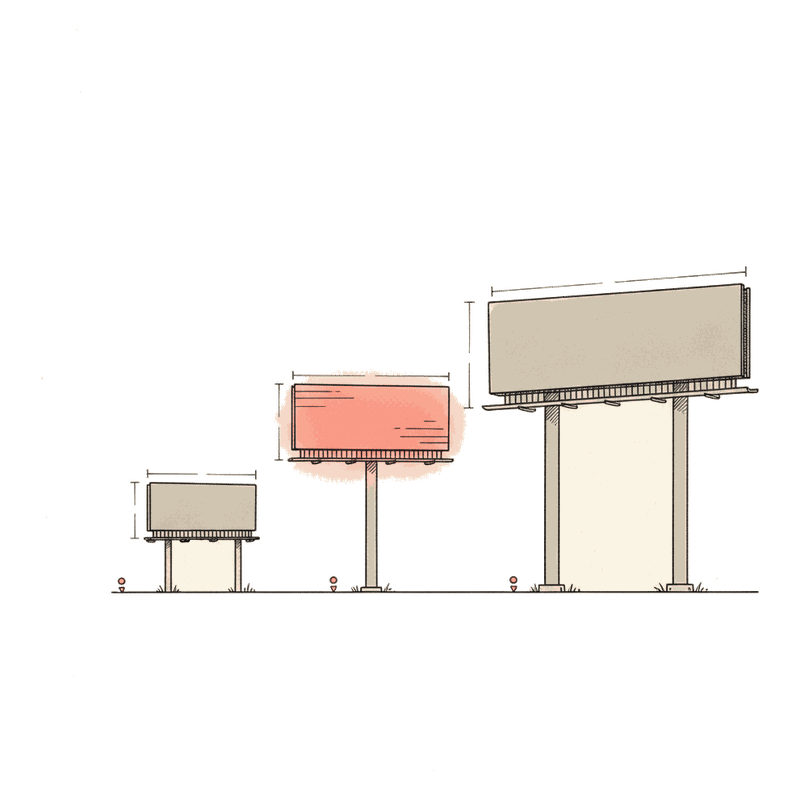
What billboard ad specs cover
"Billboard ad specs" bundles two different kinds of rules, and creative gets rejected when someone confuses them. Printed formats, a bulletin, a poster, a junior poster, have a fixed physical panel size: the vinyl or paper has to be built to that exact height and width or it prints blurry, stretched or short. Digital billboards work the other way around. There is no single standard sign size the way there is for a bulletin, because a digital face is built to fit whatever structure or venue holds it. What is standardized instead is the content: rules on what a digital billboard can show, and for how long each image stays up, published by the Out of Home Advertising Association of America (OAAA), the industry's own trade body.
This guide covers both halves. First the standard physical dimensions buyers still use as shorthand, bulletin, poster, junior poster, each with a named source. Then the digital content and duration rules that govern the screens Blindspot deals in day to day. Then how to choose between formats, and how the same specs are bought per play rather than by the panel on Blindspot.
Standard dimensions: bulletin, poster, junior poster
Decades of print out-of-home advertising settled on a handful of standard panel sizes, and buyers still use their names as shorthand even when the format itself has gone digital. The figures below come from the OAAA's own published standard OOH media format reference.
| Format | Height | Width | Approx. sq ft | Metric approx (H x W) |
|---|---|---|---|---|
| Bulletin | 14 ft | 48 ft | ~672 sq ft | ~4.27m x 14.63m |
| Poster (30-sheet) | ~12 ft 3 in | ~24 ft 6 in | No single published figure | ~3.73m x 7.47m |
| Junior poster (8-sheet) | 6 ft | 12 ft | ~72 sq ft | ~1.83m x 3.66m |
Treat poster sizes as a range, not one universal number. The 30-sheet above is the most common poster today; a 32-sheet runs smaller, closer to 10 feet 5 inches by 22 feet 8 inches. Because poster sizes vary by sheet count, the OAAA does not publish one single square-footage figure for the format the way it does for a bulletin. Metric figures are approximate conversions of the US dimensions, not a separate independent standard.
14 ft
tall, a bulletin billboard
48 ft
wide, a bulletin billboard
672
square feet, one bulletin face
6 ft
tall, the smallest standard format
A bulletin is the format most people picture when they hear "billboard": the large panel bolted high above a highway, built to be read at speed from hundreds of feet away, which is why its face runs to roughly 672 square feet, more than six times the size of a junior poster. Posters sit closer to street level and pedestrians, so they trade raw size for proximity. The junior poster, sometimes called an 8-sheet, is the smallest standard printed format and the one most often seen at eye level outside a store or on a street corner. See how these compare to modern screens in the types of billboards guide and the digital vs traditional comparison.
Digital billboard content and duration rules
A digital billboard is not measured against a fixed panel size the way a bulletin or poster is. What governs a digital sign is content policy: what it is allowed to show, and how long each message stays on screen. The OAAA's own guidance is direct on the first point. On standard-size digital billboards, commercial and noncommercial messages are shown as static images, full stop. No animation, no flashing, no scrolling, no full-motion video, outside dedicated entertainment districts built and licensed for that kind of display.
Duration is the second half, and it is less uniform. Industry practice widely rotates static images roughly every 6 to 8 seconds, so a screen with several advertisers cycles through them within under a minute. On top of that industry norm, several US states set an actual legal minimum display duration in their sign codes, commonly around 4 seconds in many states. Georgia is a documented example that requires longer, about 10 seconds minimum. There is no single national rule here: minimum display duration varies by state and jurisdiction, and the OAAA maintains its own compendium of state digital and changeable-message-sign laws precisely because the rules differ this much place to place.
For a buyer, the practical upshot is simple: build one clean static image per message, not a video, unless a specific venue is a licensed entertainment-district exception, and don't assume your creative gets a fixed number of seconds everywhere. It gets the rotation the sign's software is set to, inside whatever floor the local sign law requires. The outdoor LED billboard guide covers where these screens sit and how advertisers use them.
No animation, no scrolling, no video: a digital billboard shows one static image at a time.
The OAAA's digital billboard content rule, in one line
Choosing the right format and size
The format follows the viewer, not the other way around. A highway bulletin is read at speed from far away, so the size exists to carry a simple message that resolves in a glance: big type, one idea, minimal copy. A poster or junior poster sits closer to pedestrians and slower traffic, so it can afford finer detail and more to read without losing the audience. Neither is better; they solve different viewing distances.
Digital changes the calculation again. Because a digital face is not standardized to one universal size, the practical spec that matters is the individual screen's own resolution and duration limit, not a generic template. A creative built for one digital panel will not automatically fit another the way a 14 by 48 print file reliably fits any bulletin structure. That is why, on a self-serve platform, each screen should show its own real specs before you commit a file to it, rather than asking an advertiser to guess a one-size answer that does not exist for digital.
The other variable is time. A print bulletin or poster is fixed for the length of the flight, weeks at a stretch, because reprinting and reinstalling costs money and time. A digital screen can swap creative on a schedule, so a single campaign can run several messages across a day, or drop a message entirely outside the hours it is relevant, without a single reprint. Formats built for one long static message and formats built to rotate several short ones are simply different tools for different jobs. The history of outdoor advertising traces how the print standards came to exist in the first place, and the DOOH regulations guide covers the legal side of what a digital sign is allowed to do beyond content and duration.
Buying across formats on Blindspot
Everything above is industry-wide reference. This part is specific to Blindspot: the platform where these formats, bulletins, posters, junior posters and digital screens of every size, are booked directly, self-serve, across more than 3,000,000 screens in more than 50 countries. Every screen is priced by average cost per play, never CPM, starting near $0.23 a play on urban screens and self-serve from $40 for premium placements.
Because format and spec vary so much between a roadside bulletin and a digital panel in a mall, each screen card on Blindspot lists its own real dimensions or resolution, its accepted file types, and its duration limits before you book it, so there is no guessing a one-size spec sheet across formats that were never standardized the same way to begin with. See the full billboard cost guide for what each format runs by city, or start building a plan across any mix of formats.