Ancient origins and the age of print
Outdoor advertising is not a twentieth-century invention. According to the OAAA, ancient Egyptians used obelisks to publicize laws and treaties, carving a public message into stone in a spot everyone would pass. That is the same instinct behind every billboard since: put the message where the audience already is, rather than wait for the audience to come looking.
The medium's modern era begins with print. Johannes Gutenberg's movable type printing launched advertising's modern era through handbills in 1450, per the OAAA. The lithographic process was perfected in 1796, which made illustrated posters possible for the first time, replacing plain type with image and color. Large-format outdoor advertising as it would come to be known in America starts in 1835, when Jared Bell began printing large circus posters in New York, the origin of the large-format American poster, according to the OAAA. The earliest recorded billboard leasing followed in 1867, the first record of someone paying to rent space for an outdoor ad rather than simply posting one.
Those early posters were the direct ancestor of the printed and painted formats covered in the types of billboards guide: the same idea of a shared surface carrying a changeable message, decades before any of it was digital.
Building an industry, 1872 to 1925
Once billboard leasing existed, the people who owned the boards began organizing. The International Bill Posters' Association of North America formed in St. Louis in 1872, one of the first trade bodies for the young industry, per the OAAA. In 1891, the Associated Bill Posters' Association of the US and Canada formed in Chicago; it would later be renamed the Outdoor Advertising Association of America, the OAAA whose own published history this page draws on.
1900 brought a standardization that made national campaigns possible: a standardized billboard structure was established in America, per the OAAA, and advertisers including Coca-Cola and Palmolive began using billboards as part of national campaigns on the back of it. A shared physical format meant a poster printed once could run on boards in many cities, a precondition for advertising at national scale. The National Outdoor Advertising Bureau formed in 1915 to bring further order to the trade, and today's standard panel sizes trace back to that same 1900 standardization, covered in the billboard ad specs guide.
The industry's two halves, printed posters and hand-painted bulletins, were still organized separately until 1925, when the Poster Advertising Association and the Painted Outdoor Advertising Association merged to form the OAAA, combining posters and painted bulletins into one association, per the OAAA's own account. That 1925 merger is the direct organizational ancestor of the association that publishes the historical dates cited throughout this page.
Measurement, awards and regulation
As the industry matured, it needed data and standards as much as it needed posters. The Traffic Audit Bureau, TAB, was established in 1934 to give advertisers third-party audience data, an early ancestor of today's Geopath, per the OAAA. Independent measurement meant an advertiser no longer had to take a bill-poster's word for how many people passed a board; a third party counted instead.
The OAAA introduced the OBIE Awards in 1942, recognizing creative work in outdoor advertising, a tradition the association has kept for decades.
Regulation reached the highway system in 1965: the Highway Beautification Act was signed into law by President Lyndon B. Johnson on October 22, informally known as Lady Bird's Law. It limits billboards on interstate and federal-aid primary highways to commercial and industrial areas, bars signs within 660 feet of those highways with narrow exceptions, and requires states to set size, lighting and spacing standards. That single law shaped where a billboard could legally stand in America for the decades that followed, and the zoning and spacing rules it introduced still underpin the regulatory landscape covered in the DOOH advertising regulations guide.
The OAAA marked its own history in 1991 with a Centennial Convention, a hundred years on from the 1891 Chicago association that had become the OAAA.
Going digital
The billboard stayed a static, printed or painted surface for well over a century after 1835. The OAAA's own account dates the first digital billboards to 2005, the point at which screens capable of changing their creative without a new print run began to spread widely. Some other industry accounts place an early digital display attempt as early as 2001, a few years ahead of the OAAA's cited date, though this guide treats the OAAA's 2005 figure as the primary one.
Digital screens did more than remove the print run. Through the 2010s, programmatic buying was integrated into digital out-of-home, automating ad buying and targeting by location, time of day and conditions like weather. A format built to display one printed message for weeks could now be bought, scheduled and swapped much like display ads are bought online, a shift covered in more depth in the DOOH statistics guide and the what is DOOH primer.
The OAAA itself changed its name in 2019, from the Outdoor Advertising Association of America to the Out of Home Advertising Association of America, keeping its OAAA acronym, a small rebrand that tracked the industry's own shift from a medium of static outdoor boards to the wider, increasingly digital out-of-home category it describes today.
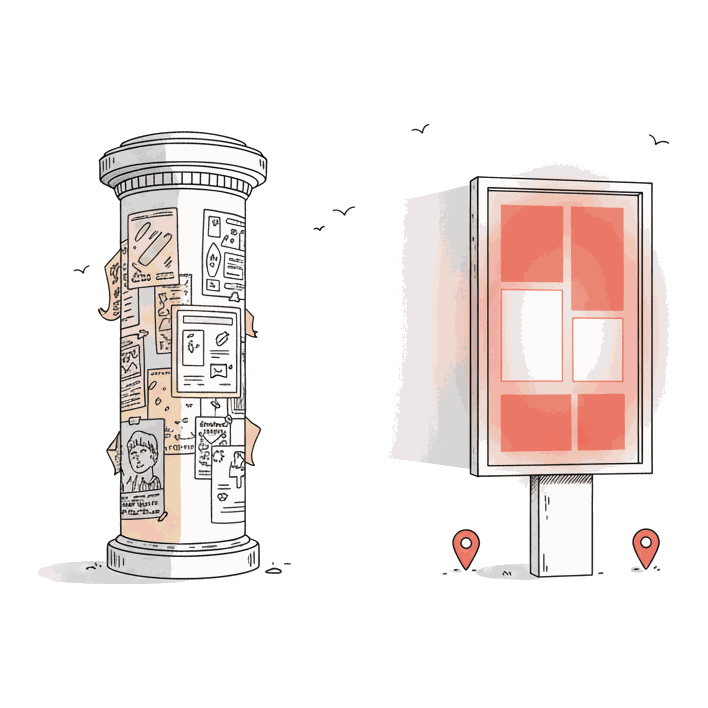
From an obelisk in the sun to a screen glowing coral, the medium never left the street.
History of outdoor advertising, in one line
Why this history matters today
576
years since Gutenberg's press launched the medium's modern era
135
years since the OAAA's Chicago predecessor organized the industry
61
years since the Highway Beautification Act became law
21
years since the OAAA's cited first digital billboards
Nearly every chapter of this history is a story about a fixed unit: a leased board, a printed poster, a flat weekly rental, sold whether or not anyone was watching. That was the only model available for most of the industry's life, because a printed or painted board could not know who was in front of it or when.
Digital screens removed that constraint, and Blindspot is built on the model it makes possible: instead of renting a screen by the week the way outdoor advertising was sold for most of its history, Blindspot prices average cost per play, the cost of one real ad appearance on one screen, from about $0.23 a play, with self-serve campaigns starting around $40. The company runs more than 3,000,000 screens in 50-plus countries, and Blinky, its free AI planner, builds a schedule from a one-line brief instead of a media buyer's phone call.
The through-line from an Egyptian obelisk to a per-play digital screen is the same one: put a message where an audience already is. What changed is what you pay for and how precisely you can prove it worked. See how the modern version of that trade works in the booking guide or the billboard cost guide.
Historical dates on this page are sourced primarily to the Out of Home Advertising Association of America's own published history of OOH, cross-checked against corroborating industry accounts where noted in the text above. Verify a date against the original OAAA history before republishing it.