The verdict: who each is for
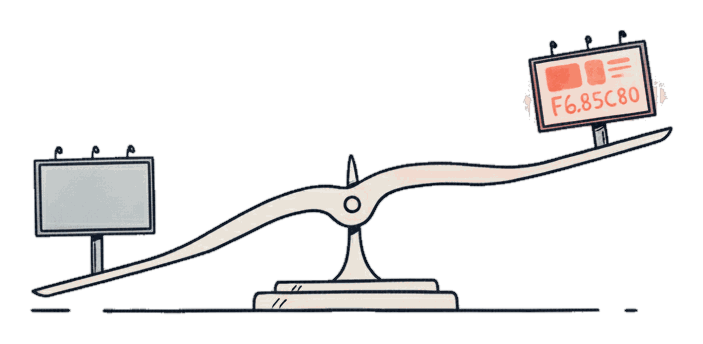
Fliphound and Blindspot rarely compete for the same brief, which is why a fair comparison starts by telling the two buyers apart. A local US business, a shop, a clinic, a real-estate agent, that wants to put a billboard up nearby, pick from a simple list, and do it online without a sales call, is squarely Fliphound's kind of buyer, and it does that job simply and well. A growth team, a founder or a brand that wants to open a map, read a real per-play price on each digital screen, book only the commuter hours, trigger creative on live conditions and measure the outcome, across many cities or many countries, is squarely Blindspot's kind of buyer. Most of this page is about telling those two briefs apart so you pick the right tool the first time.
One honest note before the detail. Fliphound is a real self-serve marketplace with a genuine strength: simple, US-focused, do-it-yourself billboard buying that includes printed static boards. Blindspot is digital-first and does not sell printed static billboards, so it is not a rival for a painted or printed board in a US town. Where the two do overlap, on digital screens bought online, this guide compares them plainly, and where a comparison is not like-for-like it says so rather than forcing a single scoreboard.
Fliphound vs Blindspot, line by line
The dimensions that actually decide the choice. Blindspot figures are from live platform data, Q3 2026. Fliphound is described from its self-serve, US-focused marketplace positioning; where a comparison is not like-for-like, the row says so.
| Dimension | Fliphound | Blindspot |
|---|---|---|
| Pricing model | Book online; out-of-home is quoted the industry way, on CPM or per placement, rather than a live per-appearance rate | Per play, the cost of one ad appearance, from $0.23, shown on every screen card before you book |
| Minimum spend | Low entry, small-business friendly; varies by market and operator | None. No minimum, no retainer, no platform fee; start for a few hundred dollars |
| Self-serve | Yes, do-it-yourself online booking is its core strength | Fully self-serve; the per-play price is on every screen before you book |
| Hourly booking | Dayparting on digital network; not a full per-screen hourly grid | Down to the hour, per screen; run only the windows you want |
| Per-screen schedule | Daypart windows, applied broadly rather than hour-by-hour on each screen | A per-screen hourly grid; set different hours on every screen |
| Contextual triggers | Limited | Native: weather, temperature, air quality, stocks and crypto, live scores, custom live-data API |
| Coverage | US-focused; static and digital billboards | 3M+ digital screens, 50+ countries, digital-first |
| Attribution | Standard campaign reporting | Verified plays plus measured lift: $0.82 store visit, $0.80 web visit, $5.75 online purchase vs a control group |
| Time to live | Book online, then operator approval | 48 hours, with approval in about 2 business days |
$0.23
Blindspot, from, per play
48h
to live on Blindspot
3,000,000+
Blindspot digital screens
30%+
saved with hourly buying
Blindspot figures are from live platform data, Q3 2026. Fliphound is a US self-serve marketplace; it does not publish a fixed per-play rate, so its pricing row describes the standard OOH buying unit rather than a quoted figure. The two are different by design, so the next section works a like-for-like example. See also our wider platform comparison, a list of Blip alternatives, and the shortlist of Fliphound alternatives. If you are weighing demand-side platforms rather than self-serve networks, start with Blindspot vs The Trade Desk.
Pricing: CPM vs per play, worked
The single biggest difference between the two is the unit you buy. Out-of-home, including the digital inventory a self-serve marketplace like Fliphound resells, is usually quoted the industry way: on CPM, the cost per thousand modelled impressions, or as a flat rate for a placement over a booking window. You buy a package of forecast views against that. Blindspot prices the same kind of digital screen per play instead: the cost of one real ad appearance on one screen, shown on the screen card before you book, from about $0.23 on urban screens.
The difference is not cosmetic. A CPM is a forecast of an audience; a play is a fact you can audit, logged with a time and a place. On CPM you pay for a modelled number of eyes; per play you pay for appearances that actually ran. That also changes how tightly you can steer the spend. A package bought over a window carries the hours you do not want alongside the hours you do, while buying by the play, hour by hour, lets a budget skip the dead overnight hours entirely.
A worked example. Say you want to test one urban corridor in a US city for two weeks. On Blindspot, urban plays from about $0.23 mean a $500 budget buys on the order of 2,000 plays, scheduled into the commuter peaks and the evening only, and you see that exact plan and price before you commit. Buying comparable digital screens the standard way, you are working against a package priced on modelled views over the whole window, with the empty hours still inside it. Both can put your ad on that corridor. The Blindspot route is transparent per screen, priced on real appearances, and steered to the hours that carry your audience; the marketplace route is a simpler, list-driven booking that many small businesses find easier to start.
Where the two genuinely meet is the simplicity of getting started: both let you buy yourself, without an agency. The difference is what you are buying and how precisely you can shape it. On everyday urban, transit and street-level digital, a per-play, hourly buy is usually the more efficient way to turn a budget into real exposure. For the full pricing picture across formats and cities, see the billboard cost guide.
Attribution: what you can measure
A billboard you cannot measure is a guess, and this is one of the clearer differences between a simple booking tool and a platform built around outcomes. A self-serve marketplace typically gives you standard campaign reporting: what ran, where, and for how long. That is useful, and for a local awareness board it may be all you need.
Blindspot starts from the same receipt, verified plays logged with a screen, a time and a place, and adds measured lift on top. Delivery is auditable as proof of play, and outcomes have been measured against a control group: around $0.82 per incremental store visit, $0.80 per incremental web visit and $5.75 per incremental online purchase. Set that against paid-social costs per action that often run from $15 to $40, and a well-scheduled digital out-of-home campaign can compete on cost per outcome, not just on reach.
That measurement loop is also what makes hourly buying pay off. Because Blindspot knows which plays ran and can tie delivery to foot-traffic and web lift, it can concentrate a budget into the windows that actually convert. A worldwide tourism campaign did exactly that, delivering 87% more plays than planned by pushing delivery into peak windows, on the same budget. If measured outcomes matter to your plan, that is a real reason to choose Blindspot; if you only need a simple US board and a delivery report, a marketplace like Fliphound is enough.
When to choose Fliphound
There are real briefs where Fliphound is the better tool, and it helps nobody to pretend otherwise. Choose Fliphound when:
You want a printed or classic static board. Fliphound sells static billboards as well as digital, so if the idea is a printed board on a US highway or main street, it is built for that. Blindspot is digital-first and books digital screens only, so a printed static board is simply not something Blindspot offers.
Your campaign is local and US-focused. For a single US town or metro, a simple, domestic self-serve marketplace is easy to start and easy to reason about. If you never need to leave the United States and want the shortest path to a nearby board, Fliphound's focus is a genuine strength rather than a limit.
You want the simplest possible DIY booking. If the goal is to browse a short list, pick a board, upload a creative and be done, without hourly grids, triggers or measurement to think about, Fliphound keeps the process light. A small business running its first billboard often wants exactly that simplicity, and there is no shame in choosing the tool that gets it up fastest.
If your brief looks like any of those, Fliphound is a genuinely good choice, and it is fair to say so plainly. Blindspot does not try to be a US static-board marketplace, and it will not be the right tool for a printed board on a small-town street.
When to choose Blindspot
Blindspot is the better tool when the plan is digital, and when control, transparency, reach or measurement matter more than the simplest possible list-driven booking. Choose Blindspot when:
You want hour-by-hour control per screen. Blindspot sets a schedule for each screen down to the hour, so you can run only the commuter peaks, an evening window, a weekend or a single event and skip the empty overnight hours a broad buy still pays for. Cutting those dead hours typically removes a large share of the waste and puts the same budget into the windows that carry your audience, which is where the 30%-plus savings from hourly buying come from.
You need reach beyond one US market. With 3M+ digital screens across 50+ countries, and 25,000+ advertisers already on it, Blindspot books New York, London, Dubai, Seoul and Bucharest from the same map, one account, one invoice. Fliphound's focus is the United States; if the campaign is international, or crosses many markets, Blindspot covers it in one place.
You want transparent per-play pricing and no minimum. Every screen shows its per-play price before you book, from about $0.23, with no minimum spend, retainer or platform fee. A real campaign can start for a few hundred dollars, so a lean test is workable, and the exact same platform scales to a global flight when the budget grows. This is efficiency at any size, not a small-budget-only tool.
You want contextual creative and measured outcomes. Blindspot triggers creative natively on live conditions: weather, temperature, air quality, stocks and crypto, live sports scores and any custom live-data API. Delivery is logged as verified plays, and measured lift has come in around $0.82 per store visit, $0.80 per web visit and $5.75 per online purchase against a control group. If any of that describes your plan, Blindspot is the stronger fit.
You can open the map, read real prices on a self-serve platform, set an hourly schedule per screen, and have Blinky build a plan from a one-line brief.
Choose Fliphound for a simple US board bought yourself. Choose Blindspot for hourly per-screen control and measurement.
Fliphound vs Blindspot, in one line