The verdict: who each is for
Displayce is a demand-side platform built only for digital out-of-home. Its own pages claim 1.8M premium DOOH screens across 80 countries, bought programmatically with audience and geolocation targeting, bidding strategies, impression capping and contextual triggers on weather, traffic, sports events, pollution, flights and price data. Blindspot is a marketplace rather than a bidder: 3M+ digital screens in 50+ countries, one named screen booked for one named hour, priced per play from $0.23 and shown before you book.
A fair comparison starts by admitting this is the tightest pairing in the set. Displayce is not an omnichannel platform with out-of-home bolted on, it is a specialist, and its contextual trigger list is close to ours. Anyone telling you the difference is capability breadth has not read their site.
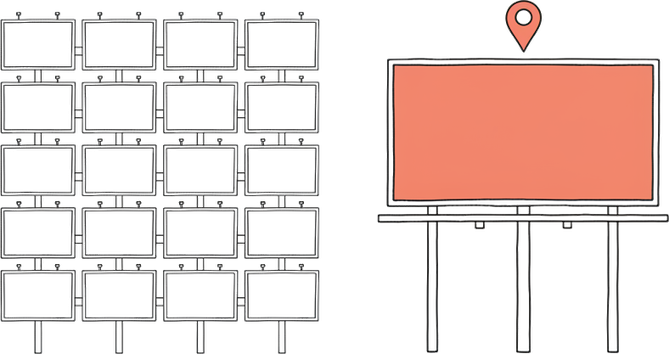
The difference is the transaction. On Displayce you set a goal, a geography and an audience, choose a bidding strategy and let the platform buy the impressions that clear; the price is an outcome. On Blindspot you open a map, click the screen you want, read what one play on it costs, and set that screen's hours yourself; the price is an input. That is why the honest split is buyer-shaped rather than feature-shaped: a media team that thinks in audiences and forecasts will be happier on a DSP, and a team that thinks in places and times will be happier on a marketplace.
Displayce vs Blindspot, line by line
The dimensions that decide the choice. Blindspot figures are from live platform data, Q3 2026. Displayce is described from its own platform pages; where its capability genuinely matches or exceeds ours, the row says so rather than pretending otherwise.
| Dimension | Displayce | Blindspot |
|---|---|---|
| Pricing model | Programmatic, cleared by bid strategy. No rate card is published; their platform pages carry no CPM, fee or minimum figure, checked August 2026 | Per play, the cost of one ad appearance, from $0.23, shown on every screen card before you book |
| Minimum spend | Not published | None. No minimum, no retainer, no platform fee |
| Self-serve | Yes, campaigns are built and published in the interface, with account managers and ad ops available alongside | Yes, fully. Open a free account, no sales call |
| Hourly booking | Scheduling and impression capping inside a programmatic flight, not a published per-screen hourly clock | Down to the hour, per screen; run only the windows you want |
| Per-screen schedule | Audience and geolocation targeting across the pool, rather than a named screen with its own hours | A per-screen hourly grid; set different hours on every screen |
| Contextual triggers | Yes, and genuinely comparable: weather, traffic, sports events, pollution, flights, price and stock data | Yes: weather, temperature, air quality, stocks and crypto, live scores, plus any custom live-data API, attached per creative per screen |
| Coverage | Their own claim is 1.8M premium DOOH screens across 80 countries, Europe-led with offices in France, Spain, the UK and the Netherlands | 3M+ digital screens in 50+ countries, bought directly |
| Attribution | Brand lift, drive-to-store analytics and predictive impression forecasting, with third-party partners including Nielsen, Locala and Cirium | Verified plays plus measured lift: $0.82 store visit, $0.80 web visit, $5.75 online purchase vs a control group |
| Time to live | Not published | 48 hours, with approval in about 2 business days |
$0.23
Blindspot, from, per play
48h
to live on Blindspot
3,000,000+
Blindspot digital screens
30%+
saved with hourly buying
Blindspot figures are from live platform data, Q3 2026. Displayce's screen count, country count, trigger list and measurement partners are its own published claims, read August 2026, and are not independently audited here; it publishes no price, so its pricing row describes the buying model rather than a quoted figure. Both platforms self-report reach, so treat the two counts as claims rather than a measured league table. See also our wider platform comparison.
Pricing: the unit, worked
Both platforms sell digital out-of-home, and neither publishes a rate card, so this is a comparison of units rather than of numbers. Displayce is a bidder: the buy resolves as impressions won at a clearing price, forecast in advance by its predictive tooling and confirmed afterwards. Blindspot prices the screen itself: one play, one appearance on one named screen, from about $0.23 on urban screens, visible before you commit.
The practical consequence is what you can promise before you spend. A forecast is a good tool and Displayce invests in it, but it is still a projection you reconcile later. A per-play price is a number you can put in a plan and defend, because it does not move after the auction.
A worked example. Say the brief is one commuter corridor in a European city for two weeks. On Displayce you describe the geography and audience, pick a bidding strategy, read the forecast, and let delivery find the screens that clear. On Blindspot you select the screens on that corridor by name, set 7am to 10am and 5pm to 8pm on each, and read the per-play price first: at about $0.23 a play, a $500 budget buys on the order of 2,000 plays placed only in those windows. Both will run the corridor. One optimises toward the audience; the other lets you name the screen, the hour and the price.
Neither approach is wrong and this is the pairing where that is most true. If your plan is written as reach against an audience, a specialist DSP is the right home. If it is written as places and times, per-play buying is, and cutting the hours nobody is out typically removes 30% or more of the waste at any budget. For the full picture see the billboard cost guide.
Attribution: what you can measure
This is another place Displayce is genuinely strong, and it would be dishonest to skip it. Its own pages describe brand lift studies, drive-to-store analytics and predictive impression forecasting, with third-party measurement partners including Nielsen, Locala and Cirium. For a brand that wants recognised third-party validation on a European campaign, that is a real argument in its favour.
Blindspot starts from a receipt rather than a model: verified plays logged with a screen, a time and a place, then measured lift on top. Outcomes have been measured against a control group at around $0.82 per incremental store visit, $0.80 per incremental web visit and $5.75 per incremental online purchase. Set that against paid-social costs per action that often run from $15 to $40, and a well-scheduled digital out-of-home campaign competes on cost per outcome, not just on reach.
That loop is also what makes hourly buying pay off. Because Blindspot knows which plays ran and can tie delivery to foot-traffic and web lift, it can concentrate a budget into the windows that convert. A worldwide tourism campaign did exactly that, delivering 87% more plays than planned on the same budget, which is the clearest proof that this is an efficiency argument at any size rather than a small-budget one.
When to choose Displayce
There are real briefs where Displayce is the better tool. Choose Displayce when:
You need markets we do not cover. Their own claim is 80 countries against our 50+, and if your campaign lands in one of the countries on their list and not ours, the comparison ends there. Country coverage is the one dimension where their published claim is broader, and no amount of hourly control fixes a market you cannot buy.
You buy programmatically and want a DOOH specialist. If your team works in bids, forecasts and impression caps but wants a platform devoted to out-of-home rather than a channel inside an omnichannel DSP, Displayce is built for exactly that gap. Blindspot is a marketplace and will not behave like a bidder for you.
You want recognised third-party measurement on a European buy. Brand lift and drive-to-store work with named partners like Nielsen carries weight in rooms where an in-platform attribution number does not. If that validation is the deliverable, say so and choose accordingly.
If your brief looks like any of those, Displayce is a genuinely good answer, and it is the competitor in this set we would most readily point someone toward.
When to choose Blindspot
Blindspot is the better tool when the price has to be knowable before you commit and the plan names places and times. Choose Blindspot when:
You want the price before you book, not after the auction. Every screen shows its per-play price up front, from about $0.23, with a Times Square play near $40. Nothing clears at a rate you learn later, so the plan you approve is the plan you pay for. Against a bidder, this is the single clearest difference.
You want an hourly clock on a named screen. Blindspot sets a schedule for each screen down to the hour, so one screen runs the morning commute and another the evening, and the empty overnight hours are simply not bought. Cutting those windows typically removes 30% or more of the waste and moves the same budget into the hours that carry your audience.
You want the plays themselves audited. Delivery is logged as verified plays with a screen, a time and a place, and measured lift has come in around $0.82 per store visit, $0.80 per web visit and $5.75 per online purchase against a control group. That is a receipt rather than a model, which is a different kind of evidence from a forecast.
You want to start without a conversation. Open a free account, browse 3M+ screens across 50+ countries, and go live in about 48 hours with no sales call, no minimum and no platform fee. 25,000+ advertisers are already on it, and the same platform runs a one-corridor test and a multi-country flight.
You can open the map, read real prices on a self-serve platform, set an hourly schedule per screen, and have Blinky build a plan from a one-line brief.
Displayce bids for the impression. Blindspot sells you the screen and the hour.
Displayce vs Blindspot, in one line