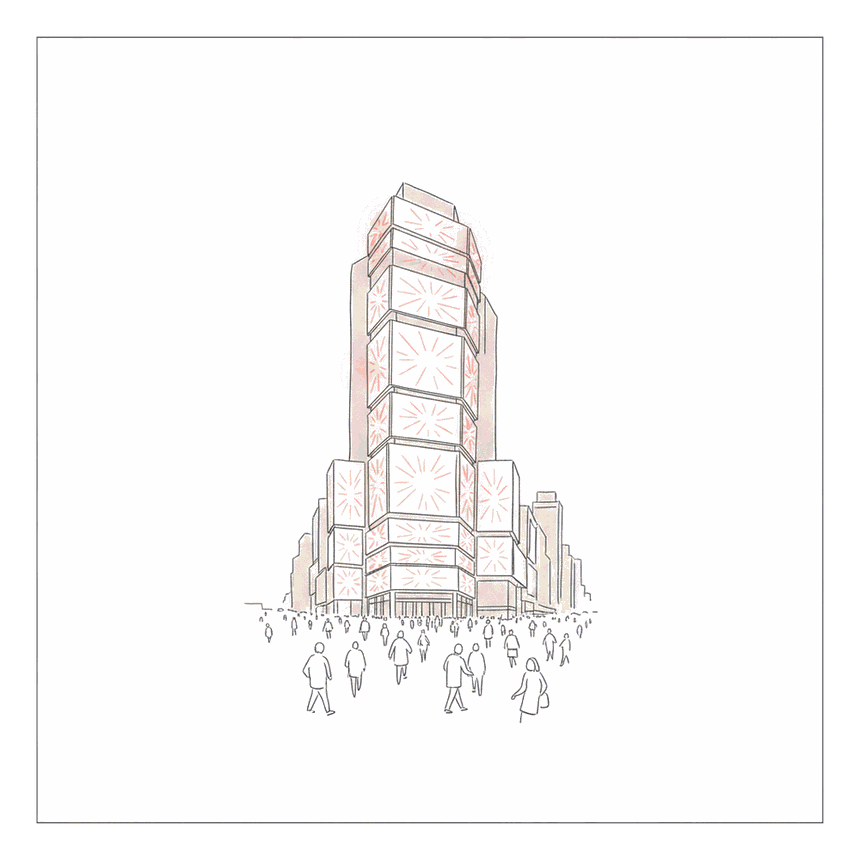
What a spectacular is, and why brands buy it
A billboard spectacular is the big one. It is the large, premium, landmark digital screen that a whole square is built around: the wrap of glowing screens in Times Square, the single curved wall of Piccadilly Lights in London, the cylindrical Nasdaq Tower, the towering vertical of The Beast. These are not ordinary roadside panels. They are the screens people cross a street to photograph, the backdrop of a thousand selfies, the shot the news cuts to when it wants to say "the heart of the city." A spectacular is a place as much as a screen.
Brands buy spectaculars for three reasons, and they stack. The first is raw reach. A landmark screen sits where the crowds already are, so a single message is seen by an enormous, continuous flow of people in a single day. The second is prestige. Appearing in Times Square or on the Nasdaq Tower signals that a brand has arrived; the place lends its stature to the name on it. The third, and the one that has grown the most, is the earned and social halo. A spectacular is not just seen in person. It is filmed, posted, shared and re-shared. One evening on an iconic screen becomes a week of social content, press pickups and screenshots, so the paid moment keeps working long after the plays stop. That multiplier is why a launch, an announcement or a milestone so often lands on a landmark screen first.
The catch, historically, has been how spectaculars were sold: as fixed, long, expensive flights, negotiated by hand, aimed only at the largest budgets. This guide covers what the landmarks are, and how Blindspot changes the buying so an iconic moment is priced by real exposure, per play and by the hour, whatever your budget. The same logic that lets you book any screen by the hour applies to the most famous screens in the world.
The landmark screens, and their formats
Not every spectacular is the same shape or serves the same goal. Some are enormous building-scale networks; some are a single, unmissable wall. Here is how the most-requested landmarks compare, and what each is best for. Every price is shown per play on the screen card before you book; the Times Square figure below is the published starting point.
| Landmark | Format | From per play | Best for |
|---|---|---|---|
| Times Square (New York) | Building-scale spectacular network | From ~$40 a play | Launches, mass reach, social proof |
| Piccadilly Lights (London) | Single curved landmark screen | Per play, shown up front | UK prestige, tourism reach |
| Nasdaq Tower (Times Square) | Iconic tower screen | Per play, shown up front | Finance, IPOs, brand trust |
| The Beast (Times Square) | Giant vertical spectacular | Per play, shown up front | Bold single-image statements |
To be clear on pricing: only the Times Square starting point (from about $40 a play) is quoted here; every other landmark shows its own per-play price on its screen card once you open it on the map, and that price is what you pay, per play, in the hours you choose. Read the deep guides for each: the Times Square screens, the Nasdaq billboard, and The Beast. For everything else the field offers, compare the platforms in the DOOH platforms guide.
The pattern across all of them is the same. A spectacular is a premium screen with a premium per-play price, because the audience it delivers in a single play is exceptional. What Blindspot changes is not the prestige of the screen; it is the shape of the buy. Instead of a negotiated, month-long minimum, you pay for the plays you actually want, in the hours your audience is actually there.
How to buy an iconic moment efficiently
Buying a spectacular on Blindspot works like buying any other screen, which is the whole point: the famous screens are not walled off behind a sales team. You open the map, find the landmark you want, and see two things immediately, the per-play price and the live availability. From there you set the hours on the same 7-day by 24-hour grid every screen uses, and the running total updates as you go. There is no request form, no minimum, and no fixed four-week commitment standing between you and Times Square.
The efficiency comes from three choices working together, and none of them means buying filler. First, per play: you pay for each real appearance of your ad on that screen, a logged fact rather than a forecast, so the price maps to exposure you can verify. Second, by the hour: you choose the windows, so an iconic screen can run only during the evening crowd, only on the launch morning, or only across a match window, and stay dark (and unbilled) the rest of the time. Third, no filler: because you are not renting a whole month, you never pay for the empty overnight hours or the dead midday lull a traditional landmark contract charges for anyway.
If you would rather not build the plan by hand, Blinky, the free AI planner, will read a one-line brief ("own Times Square on our launch evening") and propose which iconic and supporting screens to run, in which hours, within your budget. You then adjust it screen by screen and publish. Landmark screens are approved by their operator in roughly two business days, and the campaign goes live in about 48 hours, the same flow as any other screen. When you are ready, browse the screens or step through the full booking flow.
One thing worth planning for: creative on a spectacular has to earn its place. These screens are big, bright and often oddly shaped, so a single bold message, high contrast and legible from across a square, beats a busy layout every time. You can also run contextual versions, a different message when it rains, when a stock moves or when a game is on, inside the hours you scheduled, so an iconic screen shows exactly the right thing at exactly the right moment.
Efficiency at any budget
$40
from, per play, a Times Square spectacular
3,000,000+
screens worldwide
48
hours to live
50+
countries reached
The old story about spectaculars is that they are only for the biggest budgets, a six-figure month for a name most people will never book. That was true when the only way to reach a landmark was a long, negotiated, all-or-nothing flight. Buying per play and by the hour rewrites it. A spectacular moment can now last hours, not a month, so the cost is set by the exposure you actually want rather than by a flat rental you mostly waste.
Think about what that means in practice. An everyday urban panel on Blindspot starts from about $0.23 a play; a Times Square spectacular starts from about $40 a play. The gap is real, because the audience per play is not remotely comparable. But the buying model is identical: both are priced per play, both are scheduled by the hour, both show the price before you book. So a smaller brand can own a genuine, verifiable iconic moment, an evening on the Nasdaq Tower for a funding announcement, a launch morning in Times Square, without signing away a month it cannot afford. And a large brand running a global flight gets the same efficiency on its landmark screens as on the thousands of ordinary ones: every play lands in a window that carries the audience, none of the budget leaks into dead hours.
This is the same discipline that runs at the largest sizes. On a worldwide tourism campaign, Blindspot concentrated delivery into peak windows across 4,067 screens and delivered 2,146,892 plays, 87% more than planned, reaching more than 97 million people over 51 days; the breakdown is in the Visit Maharashtra case study. The mechanism scales down to a single iconic evening just as cleanly as it scales up: buy the real exposure the moment needs, in the hours it needs it, and stop paying for everything else. There is no minimum spend, so nothing forces you into more than the moment requires.
For most brands the smartest spectacular buy is not the whole month; it is the right few hours on the right famous screen, wrapped with a handful of supporting screens nearby so the moment travels. Point Blinky at the brief, pick your landmark, set the window, and publish. See the Times Square guide to start with the most famous square on earth, or browse screens and build the moment yourself.
Own an iconic moment for the hours that actually matter.
Spectaculars, in one line