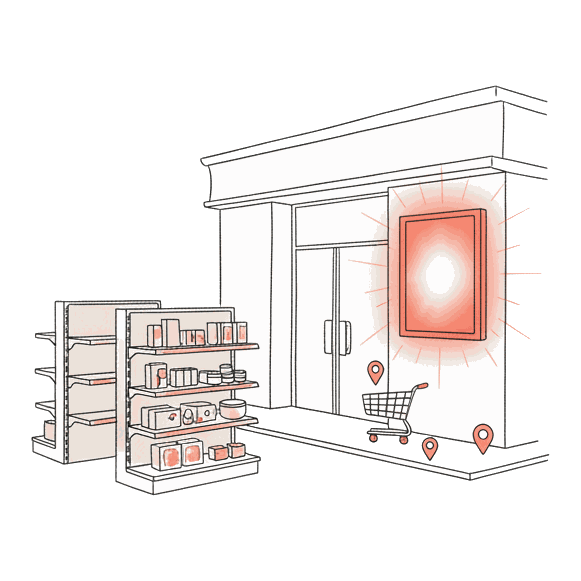
What retail media DOOH is
Retail media is advertising bought against a retailer's own audience and shown on a retailer's own surfaces: a sponsored listing in the app, a banner on the website, a promoted result in on-site search. Retail media DOOH takes the same idea into the physical world. Instead of a placement inside an app, the ad runs on a physical digital screen at or near the point of sale, the actual store, its entrance, or the surrounding retail environment. It sits alongside on-site and app placements as a third channel in the same category, one that reaches a shopper standing in the physical world rather than scrolling a phone.
The mechanism does not change from any other digital out-of-home placement. A screen shows a creative, the play is logged, and a brand pays for the plays it gets. What changes is where the screen sits and who else has a say in it: a retail media DOOH placement sits on or near a retailer's property, so a retail partner is involved in what shows and where, alongside the brand doing the advertising. For a full worked walkthrough of that idea, see the Carrefour x Beko retail media DOOH example, an illustrative case, not a reported campaign.
Why proximity to purchase matters
Most advertising reaches someone well before a purchase decision. A highway billboard builds familiarity with a brand name over weeks. A social ad reaches someone scrolling at home, with no product in front of them and no aisle nearby. Retail media DOOH reaches a shopper at a different point on that timeline: while they are already near the category, walking the aisle or approaching the store, weighing a choice that is happening right now rather than one that might happen later.
That timing changes what the screen is for. It is not the placement that introduces a brand for the first time; it is the placement that shows up at the moment a decision is actually being made, when the shopper has already chosen to be in the category and is deciding between options inside it. A brand does not need proximity for every message it runs, but for the messages meant to move a purchase already in motion, a screen near the point of sale sits closer to that moment than almost any other channel reaches.
A screen near the point of sale reaches a shopper already in the category, not weeks before.
Retail media DOOH, in one line
Where these screens live
Retail media DOOH is not limited to a screen bolted inside a store. Depending on the format available at a given location and the traffic a brand wants to reach, a retail-adjacent placement can sit in several places:
- In-store, near the relevant aisle or department.
- On the storefront, entrance or parking area just outside the door.
- In a shopping center concourse near the store.
- Elsewhere in the wider retail environment near a retail partner, such as an adjacent transit stop.
What makes a screen retail media, rather than plain out-of-home, is proximity to the purchase moment and, usually, coordination with the retail partner whose property it sits on or near, not a specific spot inside four walls. A brand and its retail partner choose the mix that fits the format and the traffic pattern at that location. The same proximity logic shows up across other categories too; see how DOOH is used more broadly in the industries guide.
Priced per play. Booked by the hour.
Blindspot does not price a retail-adjacent screen any differently from any other screen on the platform. Every placement is priced by the individual play, with an average cost per play from about $0.23, so a brand pays for plays delivered rather than a flat rental for the screen itself. There is no minimum spend, and self-serve campaigns start from $40, so the same efficiency applies whether a brand runs one screen or a hundred.
3M+
screens across 50+ countries
$0.23
average cost per play
$40
to start a self-serve campaign
50+
countries with bookable screens
Because there is no minimum spend, a brand does not need to commit to many locations at once. A single screen near one retail partner can run first, and the same booking flow scales to more locations once that first placement has been reviewed. See how this plays out in a worked, illustrative example, or read the full mechanics in the billboard cost guide.
Two names on one screen means two approvals
Whenever a brand's creative runs on or near a retail partner's property, a few things get agreed between the two sides before the first play goes live.
Creative approval. The brand's creative and the retailer both sign off on what will show, since the screen sits on or near the retailer's own storefront or floor space.
Screen selection. The brand and retailer agree which locations make sense, an entrance screen, a storefront-facing placement, or a screen closer to the relevant aisle or department, depending on the format available at that site.
A defined window. A start and end date for the placement, so both sides know exactly when the creative is expected to be live.
A way to review delivery. Once the placement is running, both sides need a way to confirm it actually played as booked. That is what delivery reporting is for; see how Blindspot's measurement works in practice.