Sell the appliance where the buying decision happens.
Arctic and Beko are two household technology brands from the same group, focused on eco-friendly, high-performance appliances. Coordinated by Catalin Cincu, they set out to promote their latest innovations to shoppers directly, in-store, where purchase intent is strongest, rather than chase attention somewhere far from the shelf.
The products carried longer buying cycles: the Arctic ExtraSteam washing machine with a 5-year guarantee, Beko HARVESTfresh refrigeration and Beko AEROperfect fan ovens, all pitched on sustainability and energy efficiency. The brief was to reach people at the moment they are already thinking about the purchase, and to measure whether it moved sales. Both were delivered on Blindspot's programmatic platform using the Carrefour digital screens network.
Quotable, self-contained, sourced · Arctic & Beko × Blindspot, 2022
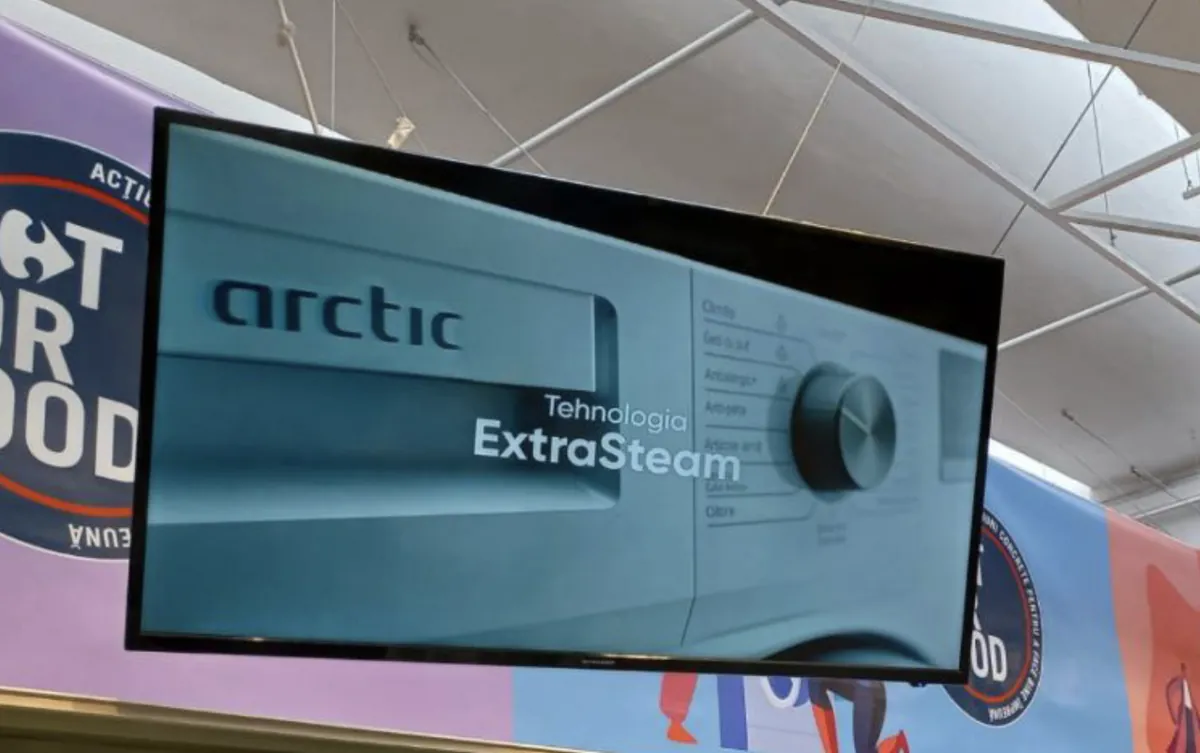
- Arctic and Beko ran contextual retail DOOH on Blindspot using the Carrefour digital screens network, across 40 supermarkets in 26 Romanian cities, with screens at store entrances, grocery aisles, gastronomy zones and fresh-product sections.
- Arctic sales rose 290% during the campaign (26 March to 15 April 2022) versus pre-campaign levels, and stayed 290% higher even after it ended, measured against a pre-campaign baseline of 17 to 25 March 2022.
- Beko sales rose 149% during the campaign (18 March to 7 April 2022) and remained 36% above pre-campaign levels afterward, with playtime scheduled programmatically and weighted to peak shopping hours.
A retail footprint, aisle by aisle
Using the Carrefour digital screens network, Blindspot activated the campaign across 40 supermarkets in 26 Romanian cities. The screens sat next to the moments that matter in a grocery run: at the entrances shoppers pass on the way in, along the grocery aisles, in the gastronomy zones and in the fresh-product sections.
Placing appliance creative inside a trusted retail network kept the message in a premium, brand-safe environment, close to the categories it spoke to. This is a Romanian sibling of the same Carrefour retail model Blindspot has run for other brands, meeting shoppers at the shelf rather than on the drive home.
Contextual timing, weighted to the rush
The campaign aligned each brand message with real-time consumer behavior. On Blindspot's programmatic platform, creatives were scheduled dynamically based on peak shopping hours and audience engagement data, so plays landed when the aisles were busy rather than looping through empty hours.
The creative leaned on the products themselves: the ExtraSteam washing machine and its 5-year guarantee, HARVESTfresh refrigeration and AEROperfect ovens, all framed on energy efficiency. Bought by the play and scheduled to the hours shoppers were present, the same flight concentrated its budget where it could actually change a decision.
The sales lift, during and after
The results showed that contextual DOOH can move even durable goods with longer decision cycles. Each brand was measured against its own pre-campaign baseline, during the flight and in the weeks after it ended:
+290%
Arctic sales during the campaign vs pre-campaign levels
+290%
Arctic sales still above baseline after the campaign ended
+149%
Beko sales during the campaign vs pre-campaign levels
+36%
Beko sales still above baseline after the campaign ended
40
Carrefour supermarkets carrying the campaign
26
Romanian cities in the footprint
Arctic sales increased 290% during its flight and remained 290% higher even after it ended, indicating strong brand recall. Beko sales rose 149% during the campaign and stayed 36% higher afterward, a pattern the source reads as delayed purchase decisions driven by DOOH influence. The measurement windows are explicit: Arctic ran 26 March to 15 April 2022 (pre-campaign 17 to 25 March, post-campaign 16 to 26 April), and Beko ran 18 March to 7 April 2022 (pre-campaign 9 to 17 March, post-campaign 8 to 17 April).


In their own words
Both the advertiser and the platform put their names to the result. Their words, verbatim:
The Blindspot DOOH solution is empowering our sales efforts with a strategic approach to indoor advertising, allowing us to amplify our campaigns in a more effective and targeted way, by meeting customers' needs while they are enjoying their usual shopping experience.
Catalin Cincu, Digital Marketing Coordinator, Arctic & Beko
We're thrilled to have been able to help Arctic & Beko add digital billboards to their general marketing mix by using the Carrefour DOOH network. Looking at sales, it's easy to see that it worked fantastically, even more than expected, taking into account we were promoting products that people usually take longer to decide over. We would partner with Arctic & Beko anytime again, to re-write this success.
Razvan Telegescu, Head of Business Development, Blindspot
Retail DOOH meets shoppers at the shelf
Moving appliances did not take a longer contract or a bigger idea. It took the right screens inside 40 stores across 26 cities, next to the aisles that matter, bought by the play and scheduled to the hours shoppers were actually there. The lift held after the flight ended, which is what you want from a purchase most people mull over.
Put the screen where the decision is made. Then the shelf moves with it.
The Arctic & Beko campaign, in one sentence
Questions, answered
What was the Arctic and Beko Carrefour DOOH campaign?
The Arctic and Beko campaign was a contextual digital out-of-home (DOOH) flight run by two appliance brands from the same group, coordinated by Catalin Cincu, and delivered on Blindspot's programmatic platform in 2022. It ran on the Carrefour digital screens network across 40 supermarkets in 26 Romanian cities, with screens placed at entrances, grocery aisles, gastronomy zones and fresh-product sections, so the message met shoppers where purchase intent is strongest. The creatives promoted the Arctic ExtraSteam washing machine with a 5-year guarantee, Beko HARVESTfresh refrigeration and Beko AEROperfect fan ovens, on an eco and energy-efficiency angle. Playtime was scheduled programmatically and weighted to peak shopping hours. During the campaign, Arctic sales rose 290% and Beko sales rose 149% against pre-campaign levels.
How did the in-store DOOH mechanism work?
Blindspot bought the Carrefour digital screens network by the play and scheduled each play programmatically, weighting delivery to the peak shopping hours and audience engagement data rather than running a fixed loop all day. Screens sat next to the relevant product categories inside 40 supermarkets in 26 Romanian cities: at entrances, along grocery aisles, in gastronomy zones and in fresh-product sections. The creative leaned on product innovation, sustainability and a limited-time 5-year guarantee, aligning each message with the shopper standing in front of the screen. Because the buy ran inside a trusted retail network on premium displays, the ads reached consumers in brand-safe environments during high-footfall windows, which is what lets contextual retail DOOH move even durable goods that carry longer decision cycles.
What results did the campaign deliver, and over what periods?
Arctic sales increased by 290% during the campaign compared to pre-campaign levels, and remained 290% higher even after the campaign ended, indicating strong brand recall. Beko sales rose 149% during the campaign, and post-campaign sales stayed 36% higher than pre-campaign levels, showing delayed purchase decisions driven by DOOH influence. The measurement windows are explicit. For Arctic: pre-campaign 17 to 25 March 2022, campaign 26 March to 15 April 2022, post-campaign 16 to 26 April 2022. For Beko: pre-campaign 9 to 17 March 2022, campaign 18 March to 7 April 2022, post-campaign 8 to 17 April 2022. Both brands were measured against their own pre-campaign baseline, so the uplift compares each brand's sales during and after the flight with the period immediately before it.
How can a brand run a retail DOOH campaign like this?
A brand can run the same play on Blindspot by choosing retail screens close to where the purchase decision happens, scheduling by the play into peak shopping hours, and measuring sales against a pre-campaign baseline. Arctic and Beko proved the model on the Carrefour digital screens network across 40 supermarkets in 26 Romanian cities, placing screens at entrances, grocery aisles, gastronomy zones and fresh-product sections and weighting playtime to high-footfall windows. The results were Arctic sales up 290% during the flight and still 290% higher afterward, and Beko sales up 149% during and 36% higher afterward. To build it, pick the store network and in-store zones, schedule programmatically to the hours shoppers are present, and compare pre, during and post sales to read the lift.