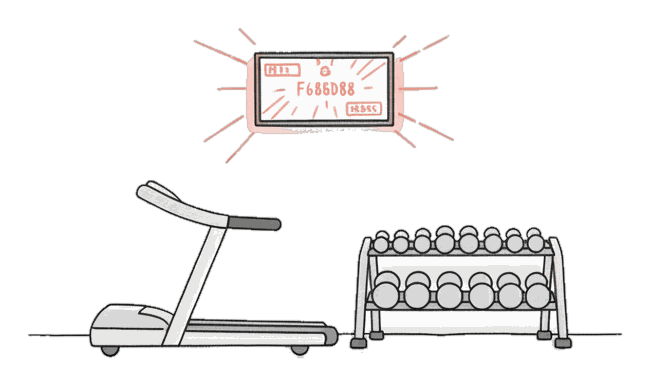
What gym DOOH is and who it reaches
Gym and fitness DOOH advertising is digital out-of-home advertising placed inside fitness venues, on the studio floor, in group-fitness rooms, on the cardio deck, across locker rooms and in club lobbies. It is the same medium as a street billboard, a digital screen playing your ad, but set in a context that changes how the ad works. A commuter glances at a roadside board for a second or two. A gym member sits with a screen in their eyeline for the length of a workout.
That difference is the whole point, and it comes down to two things: dwell and repetition. A single session runs thirty to forty-five minutes, and for much of it a member is on a treadmill, in a class or waiting between sets, with a screen a few feet away. The ad is seen for far longer than a passing impression. Then the same member comes back two, three, four times a week, so the audience is not just captive, it is recurring. Frequency, the number of times a person sees your message, is meant to build recall; a gym delivers it naturally, to the same faces, week after week.
The audience is also unusually receptive. People at a gym are, by definition, spending time and money on their health, discipline and self-improvement, so a message about wellness, nutrition, an app or better gear lands with a mindset already leaning toward it. There is little of the friction a general street screen fights. This guide covers where gym screens sit and who each placement reaches, which brands fit, how a budget buys real exposure rather than filler time, and how to book gym screens by the hour on Blindspot.
Where gym screens live and who they reach
A fitness venue is not one screen, it is several placements, each with its own audience, its own mood and its own best-fit message. The table below maps the common formats. Every screen is priced per play, with the price and live availability shown before you book, and every screen can be scheduled to its own busy hours.
| Placement | Audience | Best for | Per-play framing |
|---|---|---|---|
| Studio floor & group-fitness rooms | Members mid-workout, high attention, repeat weekly | Brand recall, apps, wearables, supplements | From $0.23, booked by the hour |
| Cardio deck & treadmill screens | Long continuous dwell, 20 to 45 minute sessions | Streaming, media, considered purchases | Per play, weight the busy class hours |
| Locker room & changing areas | Captive and unhurried, pre and post workout | Nutrition, apparel, personal care | Per play, long dwell windows |
| Club lobby, reception & juice bar | Arriving and departing members plus guests | Memberships, local services, D2C launches | Per play, peak at open and close |
The point of splitting a venue this way is that you do not have to treat it as one buy. A supplement brand can weight the studio floor and the cardio deck, where attention is highest, while a memberships promotion runs the lobby at the morning and evening open. On Blindspot each of these screens carries its own hourly schedule, so one gym campaign can run several rhythms across one building. See the mechanics in the hourly scheduling guide.
Coverage matters too. Blindspot reaches more than 3 million screens across 50-plus countries, and the fitness screens span boutique studios, big-box chains, hotel and residential gyms and specialist facilities. That means a plan can be as tight as the studios in one neighbourhood or as wide as a category launch across several cities, without changing platforms or waiting on an agency to assemble it.
Which brands should advertise in gyms
The short answer is any brand whose audience skews health-focused, disciplined and higher-intent, because the venue pre-qualifies the viewer. A handful of categories fit especially well.
Wellness and supplements. Protein, hydration, vitamins, recovery: the studio floor and cardio deck put these in front of people mid-effort, when the benefit is most tangible. A recovery drink advertised to someone forty minutes into a workout is meeting them at the exact moment the message means something.
Nutrition and food brands. Better-for-you snacks, meal plans and grocery brands land in the locker room and lobby, where a member is planning the rest of their day. The context frames the product as part of a routine rather than an interruption.
Fitness apps and wearables. Training apps, run trackers, smart rings and watches are a natural fit on the cardio deck, where the audience is already using the exact behaviour the product supports. This is one of the strongest matches on the board, and app brands pair gym screens with a QR code or a geofenced follow-up to close the loop. Digital out-of-home is a proven driver here: Blindspot campaigns have delivered incremental web visits at about $0.80 each and incremental online purchases at about $5.75, against the $15 to $40 that typical paid-social acquisition can cost, so a screen can carry a real acquisition role, not just awareness. The DOOH for startups guide walks through that math for a first campaign.
Activewear and apparel. Clothing and gear are sold on aspiration, and a gym is where aspiration is lived out. Apparel and D2C brands have long used out-of-home to drive stores and sites; Blindspot campaigns for D2C labels such as Adore Me and Intimissimi measured real lifts in store visits from screen exposure. A gym-context flight extends that into the moment a member is thinking about how they look and feel.
D2C launches and local services. A new brand, a class pass, a physio clinic, a healthy-meal delivery: the lobby reaches a warm local audience at open and close. Because there is no minimum spend, a local service can run a single club, and a national D2C brand can run hundreds, on the same self-serve platform. If you want a route beyond gyms for a broader D2C plan, the attribution guide for D2C brands covers how to measure it.
Real exposure at any budget, not filler plays
3,000,000+
Blindspot screens, 50+ countries
$0.23
from, per play, urban screen
30%+
of a buy's waste removed
48h
to live, no sales call
The most useful thing about buying gym screens per play, by the hour, is that a budget spends only on the exposure it needs. The unit is the play, one ad appearance on one screen, and the per-play price is on every screen card. There is no minimum, no agency margin and no four-week lock, so the same platform works for a first campaign of a few hundred dollars and for a category launch running thousands of screens. The size of the budget changes the number of screens and hours, not the efficiency of each one.
Gyms make the hourly control especially valuable, because fitness traffic is peaked, not flat. A club fills at the morning open, empties through the working day, and fills again from late afternoon into the evening, with weekend mornings busy too. A fixed flight pays the same for the dead mid-morning hours as for the packed evening rush, and those empty hours are pure waste: the plays run, the money leaves, and almost no one is there. Booking by the hour drops them. You buy the busy class windows only, which typically removes 30% or more of the waste a full flight carries, and the freed budget buys more plays when the floor is full.
A worked example. Say a studio screen costs about $0.23 a play and you would run it every hour of every day. Roughly a third of those hours, the deep mid-morning lull and the overnight, carry very little audience. Cutting them removes about 30% of the plays and about 30% of the spend without losing a single useful appearance, and the same money then delivers more plays at the peaks that matter. How much you save scales with how peaked the venue is, and gyms are among the most peaked venues there are.
This efficiency is not a small-budget trick; it is what makes big flights work too. On a worldwide tourism campaign, Blindspot ran 4,067 screens and reached more than 97 million people over 51 days, and by concentrating delivery into peak windows the campaign delivered 2,146,892 plays, 87% more than planned. The full breakdown is in the Visit Maharashtra case study. The mechanism is the same in a single studio or across a country: put the plays where the people are.
How to buy gym screens on Blindspot
Booking is fully self-serve, so none of this needs a media buyer or a sales call. You open the map, filter to fitness and gym venues, and pick the screens you want. Each screen shows its per-play price, its formats and its live availability, and the running cost updates as you build the plan. You then paint an hourly schedule for each screen, so a studio-floor screen can run heavy through the evening class block while a lobby screen runs the morning and evening open, add your creative, and publish.
If you would rather not build the plan by hand, Blinky, the free agentic AI planner, reads a one-line brief and proposes the screens and hours for you, which you can then adjust screen by screen. Blinky draws on more than 7 million data points about how audiences move through a place, so its first draft already weights the plan toward the busy fitness windows. On top of the schedule, a creative can also fire on live conditions, weather, temperature, air quality, prices or a custom data feed, so a cold-weather recovery drink or a New Year membership push can show only when the moment fits.
Screens are approved by their operator in roughly two business days and campaigns go live in about 48 hours. When the flight ends you get verified proof of play, a log of exactly which screens ran your ad, when and where, which is the receipt behind any measurement you report. To see the wider platform and how gyms compare to other venues, read the best DOOH platforms guide, or browse screens and start building. There is no need for a big budget to begin; there is only a need for the right hours.
Few audiences sit still. Gym members do.
Gym and fitness DOOH, in one line