What an agency gets from Blindspot
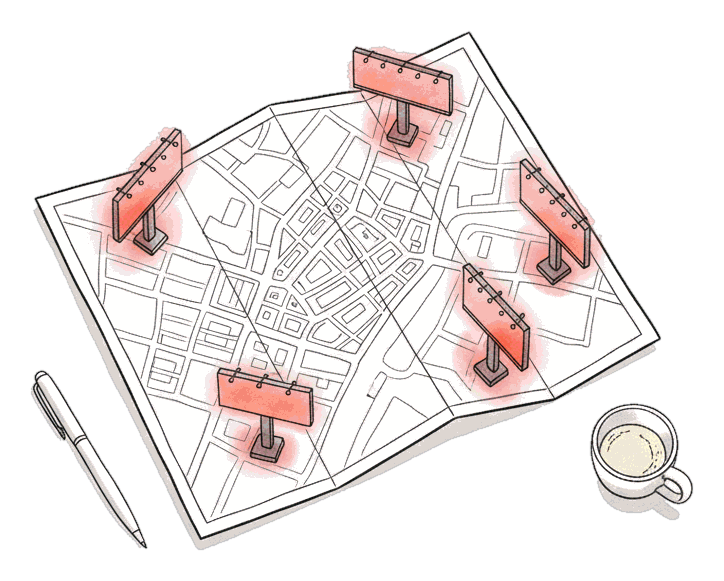
For an agency, the practical difference is control and speed. Instead of briefing a media owner, waiting for a rate card, and reconciling a four-week flight against a CPM package, a planner opens the map, filters to the cities and formats a client needs, and builds the plan in an afternoon. The same account handles a founder-led local launch and a multi-country push, so a team does not switch tools between a small retainer and a flagship brand. Blindspot already serves 25,000-plus advertisers on this model, and the machinery underneath a small buy is the same machinery that runs a worldwide flight.
It also removes a source of friction that most agencies simply live with. When each market means a new media owner, a new rate card and a new invoice, a multi-country plan turns into weeks of coordination and a reconciliation headache at the end. On Blindspot the whole plan sits in one account, on one map, with one running cost, so a planner can add a city to a brief without adding a vendor. That matters most for the mid-market clients an agency wins on responsiveness rather than on retainer size, where the win is often simply moving faster than the media owner can quote.
3M+
screens on one map
50+
countries
$0
platform fee
48
hours to go live
With no markup skimmed from the buy, a client's budget of any size buys more real exposure and less filler, and the same efficiency runs a local test as easily as a national flight.
Agency needs, and how each is handled
What an agency actually needs from a DOOH platform, how Blindspot handles it, and what the same need costs you on a typical managed-service or DSP alternative. This is where the model differences show up in the work, not just the pitch.
| Agency need | How Blindspot handles it | Typical managed-service alternative |
|---|---|---|
| Multi-market planning | One map, 3M+ screens, 50+ countries, planned and booked in the same account. | Juggling separate operators per country, or licensing a DSP seat to reach them. |
| Client reporting | Verified, geo-tagged, time-stamped proof-of-play for every appearance, exportable. | Modelled CPM estimates you cannot audit line by line. |
| Margin | No platform fee, no markup, per-play transparency, so your margin is yours. | Media markups plus a managed-service fee taken in the middle. |
| Speed | Self-serve, live in about 48 hours after creative approval, no sales call. | Weeks of briefing, rate cards and negotiation before a screen turns on. |
| Precision | Per-screen scheduling down to the hour, plus contextual triggers. | Flight-level buys that rent screens around the clock. |
Managed and agency OOH commonly adds a media markup on top of a four-week flight; demand-side platforms such as The Trade Desk and supply-side networks such as Vistar require a seat or a partnership to transact. Blindspot removes both the seat and the middle fee. See how a plan comes together in the platform overview, or compare options in the platform comparison.
Can Blinky turn a client brief into a plan?
Yes. Blinky is Blindspot's free agentic AI planner, and it is built for exactly the moment an agency lives in: a brief lands, and a plan is due. You upload or paste the brief, the audience, the markets, the budget and the flight, and Blinky returns a screen-by-screen plan you can review, edit and price in minutes, not the days a manual media plan takes. Every screen it picks carries its own per-play price and hourly schedule, so the plan you show the client is the plan you book, with no gap between the pitch and the buy.
For a planner, this changes the economics of a pitch. You can build three genuine plan variants for a new-business meeting in the time it used to take to email one media owner. You can adjust the market mix live in front of a client, watch the plays and the cost move, and export the plan straight into a deck. Because Blinky reads the same live screens the platform books from, nothing is a mock-up, the availability and the prices are real. Blindspot supports agency-grade planning of this kind directly, and has taken it to holding-company media teams, so the workflow is built for the way an agency actually pitches and buys.
The agency stays in control the whole way. Blinky drafts and recommends; a planner approves, trims, reweights and books. Contextual triggers can run inside the plan, so a client's creative can change with weather, temperature, air quality, a stock or crypto move, a live sports score, or a custom live-data feed, all live in production today. That is a level of precision a client can see, and a reason to bring the work in-platform rather than out to a desk. Read more on the Blinky AI planner, or request a media plan and see one built for a real brief.
Is the delivery good enough for client reporting?
The honest test of an agency platform is not the plan, it is the report you hand back. Blindspot's largest published campaign, the worldwide Visit Maharashtra tourism flight, is a clean example of agency-grade delivery and reporting at full size. It ran 4,067 screens across 20 cities in 15 countries, reached more than 97 million people, and delivered 2,146,892 plays, which is 87% more plays than planned, across all 51 of 51 flight days with no missed day.
The reporting is where it matters for a client relationship. The campaign shipped weekly reporting backed by operator certificates, so every claimed play was tied to a named operator's confirmation, and it was measured against an eight-part KPI framework agreed up front rather than a single vanity number. That is the evidence trail an agency needs to defend a spend and win the renewal: what ran, where, when, and against which target. The same verified, geo-tagged, time-stamped proof-of-play sits behind every campaign on the platform, whether it is a founder's one-city test or a global flight, so your smallest client gets the same standard of proof as your largest. Read the full breakdown in the Visit Maharashtra case study.
The agency addendum
Agencies buying on behalf of clients have their own commercial and legal needs: how media is contracted, how billing and margin are treated, and how responsibility is split between the agency and Blindspot. Those terms are set out in a dedicated agency addendum that sits alongside the standard platform terms. It is the reference for how an agency account works commercially, and it is the right document to bring to a procurement or legal review before a first client flight.
In short, the platform is built so an agency can run many clients from one account without a seat fee, keep a transparent per-play cost the client can see, and keep its own margin on top. If you want to walk through how the addendum applies to your setup, or how billing works across multiple clients, get in touch, no sales call is required to start.
Nothing is skimmed in the middle, so your margin stays yours.
This guide, in one line