Why DOOH works for real estate
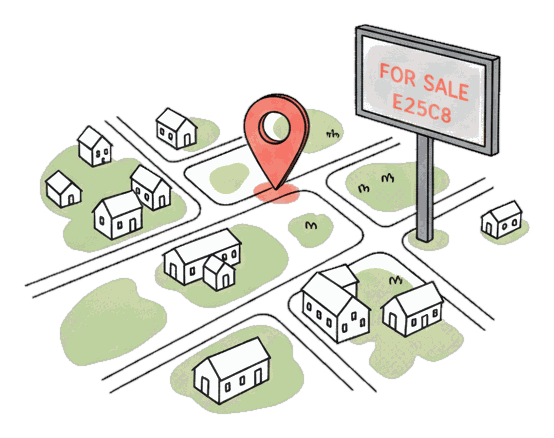
Two things make real estate a natural fit for digital out-of-home, and both come down to place. The first is that property is inherently hyperlocal. A buyer for a three-bedroom in a specific district is usually already in or near that district; a homeowner deciding which agent to call knows the signs and the faces they see on their own streets. A screen on the right corner reaches those exact people in the physical space the decision happens in, which no feed can claim. The value was never the size of the screen, it was standing in front of the audience where they already are.
The second is trust. A billboard is a public statement, and in a category where people are handing over the largest purchase of their lives, being visible on the streets a buyer walks reads as permanence and confidence in a way a social ad does not. Agents have always known this, which is why bus-shelter posters and bench ads have been a fixture of the trade for decades. What held real estate marketers back was how that screens were sold: through a media buyer, in long flights, on citywide networks, with a bill that made sense only for a national developer and a report that arrived weeks later.
Digital out-of-home, bought self-serve, removes each of those frictions. Instead of a citywide flight you buy the specific panels inside a catchment. Instead of a 4-week commitment you schedule each screen down to the hour, so a weekend open house or a weekday commute is covered and the empty overnight hours are not. Instead of a modelled report you get a log of every play with a time and place, tied to real foot traffic. More than 25,000 advertisers already buy this way on Blindspot, across 3M+ screens in 50+ countries, and the smallest of them run a single listing that a traditional agency would not have taken the call for.
Four goals, four zones, mapped
Real estate DOOH is not one campaign, it is a handful of distinct plays, each with its own zone, budget shape and outcome. The table below sets the common four against the things that decide the buy: where the screens sit, roughly what it costs, and what you should hold it to. Budgets are order-of-magnitude framing at about $0.23 a play, not a quote; your own figures appear live as you build a plan.
| Goal | Zone Blindspot targets | Budget band | Measured outcome |
|---|---|---|---|
| Single listing | The blocks around the property plus the nearest commuter routes | A few hundred dollars, a week or two | Walk-ins and listing-page visits from local buyers |
| Open house | The immediate catchment, weekend daytime windows only | A small weekend burst | Foot traffic to the open house that weekend |
| New development | Feeder neighbourhoods and arterial routes into the metro | Low to mid four figures over the sales window | Sustained awareness and walk-ins to the sales gallery |
| Agency brand | The agent's farm area, the postcodes they list in | An ongoing monthly line | Recall when a homeowner decides to sell |
The common thread is that each zone is a real geographic catchment, not a citywide network, and each schedule is a real window, not a round-the-clock rental. A single listing wants the blocks a buyer would drive; a development wants the routes people take home from work; an agent's brand wants the streets they already list on, seen often enough to be top of mind when a neighbour decides to sell. Because there is no minimum spend, the small plays are as buildable as the large ones. Read the minimum budget guide for the full breakdown, or see the wider platform comparison.
Targeting a catchment, and measuring the foot traffic
The reason a neighbourhood buy is possible at all is that you are not renting a screen network, you are picking individual panels on a live map. On Blindspot you draw the catchment that matters, the blocks around a listing or the postcodes an agent farms, and add only the screens inside it to a plan. Each screen shows its own per-play price and availability, so you can see exactly what the corner outside a development costs before you commit. There is no citywide floor to buy through and no negotiation to sit through; the whole budget goes to the panels your buyers actually pass.
Then you schedule those panels by the hour. A listing wants the evening commute and the weekend, when people who are house-hunting are out and moving; an open house wants Saturday and Sunday daytime and nothing else; a development launch wants the arterial routes at the morning and evening peaks. Buying only those windows, rather than paying for a screen around the clock, is where the efficiency comes from, and it is a control a media buyer would once have charged to set up. Contextual triggers are live in production too, so a development creative can react to weather, a live event nearby, or any signal you pipe in, which turns a static poster into something that reads the moment. See how the hourly grid works in hourly billboard scheduling.
Measurement is what lets a real estate marketer justify the spend to a vendor or a developer, and this is where digital out-of-home now competes with any online channel. Blindspot logs every play with a time and place, and a campaign is attributed to real outcomes rather than modelled impressions. The two that matter for property are foot traffic and web visits: the screens around a development tie to the walk-ins at its sales gallery, and the QR code or listing URL on the creative ties to traffic on the listing page. Public Blindspot results record $0.82 per incremental site visit and $0.80 per incremental web visit, both attributed to real exposure. Set that next to the cost of putting a listing in front of the same local audience any other way and the comparison holds up. The full method is in the attribution guide.
$0.23
typical urban play
$0.82
per incremental site visit
48
hours to live
30%+
saved buying by the hour
None of this depends on a big budget, it depends on buying only useful plays. Because each screen is scheduled down to the hour, cutting the empty overnight and dead-zone hours a traditional flight pays for, buying by the hour typically removes 30% or more of the waste, so the same money buys more of the appearances that convert into a walk-in. For a listing that means every dollar sits in the hours a buyer is actually driving the street, and for a development it means the launch budget lands on the commute rather than the small hours.
Efficiency at any budget
The point of buying this way is not that it is cheap, it is that the budget works as hard as it can at whatever size you set it. A solo agent with a few hundred dollars and a national developer with a five-figure launch use the same map, the same per-play prices and the same hourly controls; the only difference is how many blocks and how many hours they cover. At a typical urban per-play of about $0.23, $500 buys roughly 2,100 plays and $2,000 about 8,700, so a single listing can own its blocks for a week and a development can own its feeder routes for a month.
No minimum spend is the aside that makes the small plays possible, not the headline. The headline is efficiency: because you buy the exact panels and the exact hours, the budget is not diluted across screens your buyers never pass or hours they are asleep. That efficiency is the same mechanism that let a worldwide campaign for Maharashtra Tourism deliver 87% more plays than planned, 2,146,892 verified plays across 20 cities in 15 countries. A developer running a national rollout gets that same concentration; an agent running one street gets it too, at their scale.
Buy the blocks your buyers pass, in the hours they pass them.
This guide, in one line
To see exact figures for a specific catchment, open a free account and build a plan, or browse the map for New York, Miami or Los Angeles. Premium landmark screens cost far more per play, near $40 in Times Square, and buy fewer appearances for the same money, which is why most real estate campaigns start on neighbourhood panels and spend up from there.
How to launch on Blindspot
Running a real estate campaign is a self-serve process, and it takes minutes to set up rather than weeks to negotiate. You open a free account, then draw the catchment on the live map and add the screens inside it: the corners around a listing, the routes into a development, the postcodes an agent farms. Every screen shows its per-play price and availability, so the plan is priced as you build it, not quoted back to you later.
Next you set the schedule for each screen down to the hour, matching the windows to the goal: weekend daytime for an open house, the evening commute for a listing, the morning and evening peaks for a development launch. You upload the creative, a single clear message with the property, the price and a QR or listing URL, and publish. Approval takes about two business days and the campaign is live in 48 hours, with no retainer and no media-buyer fee. If you would rather not build the plan by hand, Blinky, the free AI planner, drafts a full campaign from a one-line brief, draws the catchment, sets the hours and hands it back for you to approve, which is the closest a real estate marketer gets to an agency without paying for one.
Once it is running, you read the results the way you would read a storefront: verified plays, incremental foot traffic to the property or sales gallery, and listing-page visits from the QR. That gives a cost per outcome you can put in front of a vendor to win the next instruction, or in front of a developer to justify the next phase. Start on the platform, or browse the screens on the map.