A screen that reacts to the shopper in front of it
Most in-store screens run one fixed loop, all day, for whoever happens to be standing there. Samsung wanted the opposite: retail displays that read the room and change the message for the actual person who just walked in.
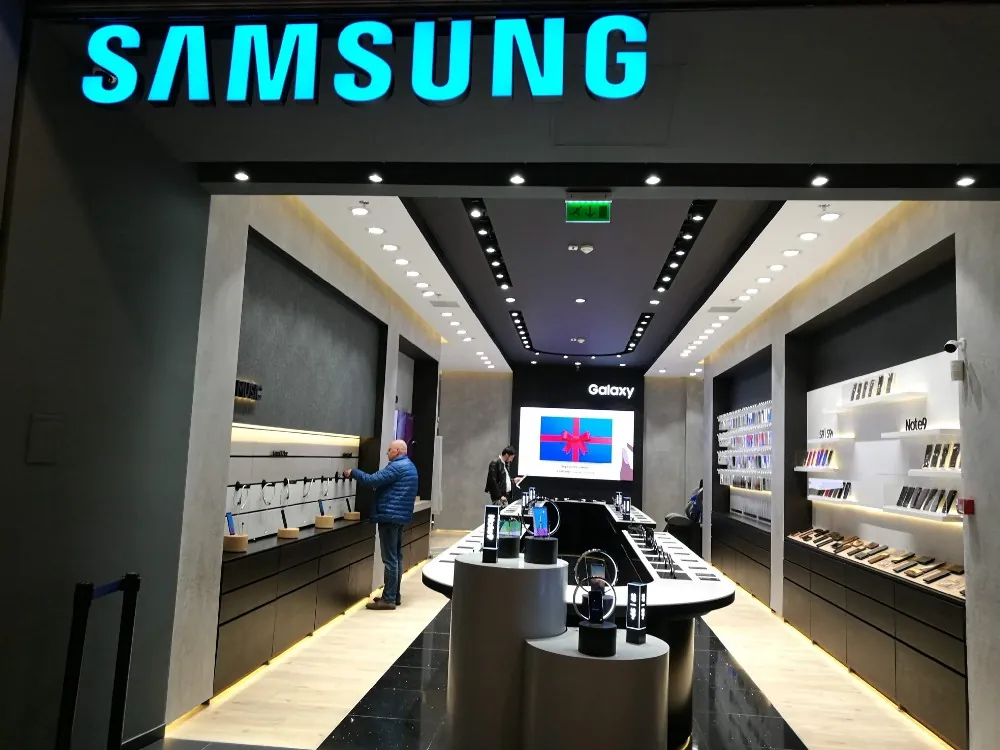
The deployment ran at the Samsung Experience Store in Baneasa Shopping City, Bucharest, built with the technology partner omniX Labs and delivered on Blindspot. The idea was simple to state and hard to do: sense who is in the store, match them to the right creative, and put that creative on a nearby screen fast enough to matter. This page is about that mechanism, told concretely.
Quotable, self-contained, sourced · Samsung × omniX Labs × Blindspot
- Samsung ran a real-time, in-store DOOH deployment at its Samsung Experience Store in Baneasa Shopping City, Bucharest, built with technology partner omniX Labs and delivered on Blindspot, using Galaxy Note9-era creative on the store's in-store displays.
- omniX Labs tracked foot traffic, visitor demographics and in-store behavior; Blindspot matched that audience data to creative and triggered the relevant ad on nearby screens within seconds, in real time and with no manual intervention from store staff.
- The deployment ran on Blindspot's pay-per-play pricing with zero minimum spend, so the same real-time in-store approach is open to smaller retailers and emerging brands, not only flagship advertisers. No deployment-specific results were published, so none are claimed here.
Two systems, one short loop
The deployment split cleanly into sensing and serving. omniX Labs did the sensing: it tracked foot traffic, read visitor demographics on entry, and picked up behavioral signals, like which product categories drew attention and whether shoppers arrived solo or in a group. Blindspot did the serving: it matched that live audience signal to the right creative asset and triggered the ad on the nearest screen, in real time.
The whole path from identifying a shopper to serving the ad ran within seconds, with no manual intervention from store staff. Because Blindspot buys DOOH by the individual play rather than renting a screen for a fixed block, each triggered ad is a discrete, billable event, which is exactly what lets a screen switch its message for the room instead of looping the same clip all day.
Baneasa, Bucharest, the Note9 window
The setting was a working flagship: the Samsung Experience Store in Baneasa Shopping City, Bucharest, with a Galaxy wall, product plinths and in-store displays already part of the retail floor. The creative that ran on those screens was from the Galaxy Note9 launch window, alongside the wider Galaxy line of flagship smartphones, wearables and tablets.


In-store personalization, bought by the play
Two things make this deployment worth reading. First, the loop is real-time and hands-off: a shopper is sensed, matched and served in seconds, without anyone on the shop floor touching a screen. Second, the buying model is per-play with zero minimum spend, so the same approach is not gated to a brand the size of Samsung. A smaller retailer or an emerging tech brand can run the same real-time in-store play and pay only for the plays that fire.
One honest note on results. Samsung and its partners did not publish deployment-specific figures for the Bucharest store: there are no play counts, reach numbers, sales-lift or recall percentages tied to this run, so this page states none. Where a Blindspot campaign does carry measured outcomes, they come from a geo-tagged, time-stamped proof-of-play record. For this deployment, the claim is the capability, demonstrated in a live store, not a metric.
The screen should know who it is talking to
A fixed loop treats every shopper the same. A sensed, matched, per-play screen treats the store as what it actually is: a stream of different people, each worth a different message. Samsung's Bucharest deployment put that idea on a real retail floor, with omniX Labs reading the room and Blindspot serving the answer within seconds.
Sense the room. Then serve the screen to match it, one play at a time.
The Samsung in-store deployment, in one sentence
Questions, answered
What was the Samsung in-store DOOH deployment?
It was a real-time, in-store digital out-of-home (DOOH) deployment at the Samsung Experience Store in Baneasa Shopping City, Bucharest, Romania, built with the technology partner omniX Labs and delivered on Blindspot. Inside the store, omniX Labs tracked foot traffic, visitor demographics on entry and in-store behavior, such as which product categories shoppers browsed and whether they arrived solo or in a group. Blindspot's ad-serving platform matched that audience data against the store's creative assets and triggered the most relevant ad on nearby screens, in real time and with no manual intervention from store staff. The creative was from the Galaxy Note9 launch window, alongside the wider Galaxy line, and it played on the store's in-store displays. The whole point was to show retail screens reacting to the actual shopper in front of them.
How did the real-time personalization work?
The deployment ran as a short loop between sensing and serving. omniX Labs handled the sensing: it read foot traffic, visitor demographics and behavioral signals, including which product categories drew attention and whether shoppers moved as individuals or in groups. Blindspot handled the serving: it matched that live audience signal to the right creative and triggered the ad on the nearest in-store screen within seconds, with no store staff pressing anything. Because Blindspot buys DOOH by the individual play rather than by renting a screen for a fixed block, each triggered ad is a discrete, billable play. That is what lets a screen change its message for the room in front of it instead of running one fixed loop all day. The Galaxy Note9-era creative was the campaign that ran on those screens.
What did the deployment cost to run?
It ran on Blindspot's pay-per-play pricing with zero minimum spend, and hourly buying flexibility. Instead of a fixed screen-rental contract, each ad play is paid for on its own, so the cost tracks the plays that actually fire. That pricing is the reason the model is not limited to a brand the size of Samsung: because there is no minimum commitment, the same real-time in-store approach is open to smaller retailers, startups and emerging tech brands, not only to flagship advertisers. The metric that matters here is the average cost per play, and the buyer only pays for the plays a live audience triggered. This is the standard way campaigns are booked and billed on Blindspot.
What results were measured in this deployment?
This is a mechanism deployment, not a results report, and it is presented that way here. Samsung and its partners did not publish deployment-specific figures for the Bucharest store: no play counts, reach numbers, sales lift or recall percentages tied to this run were released, so none are stated on this page. What the deployment demonstrates is the working loop itself: omniX Labs sensing the room, Blindspot matching creative to the audience and triggering ads within seconds, all on pay-per-play pricing with zero minimum spend. Where a campaign does carry measured outcomes, Blindspot reports them from a geo-tagged, time-stamped proof-of-play record. For this deployment, the honest claim is the capability, told concretely, rather than a number.