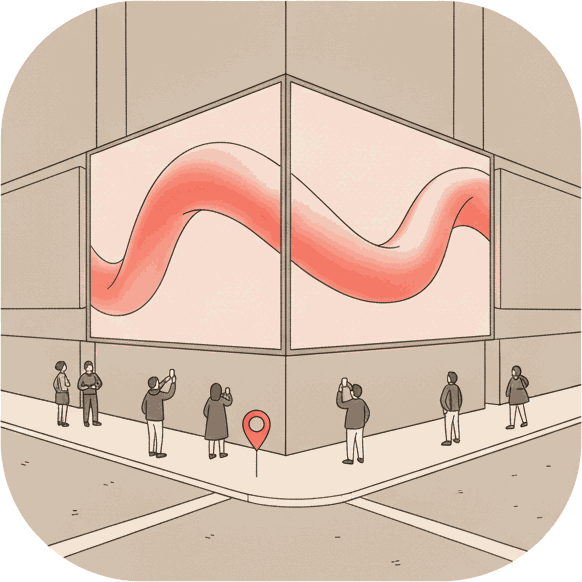
What an anamorphic billboard actually is
Start with the word. Anamorphosis is an old art technique: a distorted image that resolves into a correct picture only from one specific viewpoint, the trick behind stretched skulls hidden in Renaissance paintings and chalk drawings that look three-dimensional from a single spot on the pavement. An anamorphic billboard is that same idea, moved onto a modern LED screen. The screen is completely flat. What changes is the video played on it: content built with the false depth baked in, so that from one exact viewing angle, and only from that angle, an object appears to have real volume and to be breaking physically out of the frame.
That is the whole trick, and it is worth being plain about it because the format gets oversold as futuristic hardware. There is no glasses-free hologram, no volumetric projector, no screen that physically bends into a box shape. It is a standard flat digital display and a piece of video built for forced perspective. Step to the side of the sweet spot and the illusion collapses, the "3D" object reads as a flat, slightly warped shape on a screen, the same way a chalk pavement drawing looks wrong from any angle but the one it was drawn for.
How the illusion works
The content is built with a virtual camera positioned exactly where a real viewer's eye will be, usually across a street or on the far side of a plaza. Every edge, shadow and highlight in the 3D animation is rendered from that one virtual vantage point, so the flat image on the screen lines up with what a person standing in the real sweet spot expects to see from real-world objects at that distance. Move the virtual camera, and you have to rebuild the content; the geometry only works for the angle it was designed for.
Corner installations push the trick further. An L-shaped screen, two flat LED panels meeting at a building's outside edge, lets the content flow across both faces at once, so an object can appear to bend around the corner and push past the screen's own physical boundary into open air. That is the detail that sells the illusion: the object does not just sit inside a rectangle, it looks like it has escaped one. It still needs the right screen geometry to start with, correct pixel pitch for how close the crowd stands, and a production process closer to short-film 3D animation than a resized static ad.
Real examples of the format
Piccadilly Circus in London has hosted several notable anamorphic 3D activations on its digital screens. An Amazon Prime Video campaign for the series "The Wheel of Time" used the format, and a Glenfiddich whisky activation showed the brand's stag appearing to leap out of the screen and over the crowd below.
COEX Square in Seoul hosted "The Wave" in 2020, widely cited as one of the first broadly recognized modern anamorphic 3D digital out-of-home installations: a massive LED screen showing a realistic ocean wave that appeared to move in three dimensions inside the display. K-pop Plaza in Seoul has also carried 3D anamorphic ads from automotive brands on a large Samsung LED screen, using the same forced-perspective principle so vehicles appear to burst out of the screen toward the plaza.
These are examples of the anamorphic 3D format as it has been used in the real world, credited to their own brands, agencies and installations. They are not Blindspot campaigns, and they are described here only to illustrate how the technique reads at real locations.
Where this fits a campaign
Anamorphic 3D is a high-impact, single-location format, not a reach format. It needs one screen with the right shape, one sweet spot, and content built specifically for that spot, so it does not scale the way a normal digital campaign scales across hundreds of screens. Think of it as the billboard equivalent of a launch stunt: the flagship moment for a product drop, a premiere, or a brand relaunch, run at one landmark plaza rather than spread thin across a city or a country.
The payoff is that these installations tend to travel past the people standing in front of them. A crowd filming a three-dimensional object appear to leap off a screen is exactly the kind of clip that gets reshared, so the physical audience at the plaza is usually only the start of who ends up seeing it. That makes the format worth the extra production effort for a single big moment, and a poor fit for an always-on or geographically broad plan, where a normal billboard creative across many screen formats and venues will reach more people for less.
One flagship screen, built for one exact angle.
Anamorphic 3D, in one line
What it takes to try one on Blindspot
Not every screen supports this. A standard flat outdoor LED billboard can carry the content, but you need one mounted at a corner, or better, two adjoining panels meeting at a building's edge, so the object can appear to break past the boundary rather than sit flat inside a rectangle. When picking a screen for the format, check its physical shape and mounting before booking anything, not just its size or location.
The creative is the harder half of the job. This is not a resized version of a normal ad; it is a short 3D animation matched to the screen's exact geometry and the intended viewing angle, closer in production terms to a specialized design build than a standard static or video upload. Most brands bring in a motion or 3D studio for this part, then hand the finished file over the same way they would any other creative.
Once the creative exists, the screen itself is priced and booked the same way as any other placement on Blindspot: per play, in USD, never CPM, with the running cost shown before you commit.
3M+
screens on Blindspot, worldwide
50+
countries covered
$0.23
average cost per play, from
$40
where self-serve booking starts
No minimum spend and no sales calls stand between picking a screen and going live, the same as every other format on the platform. See how booking works to check screen shapes in your target city before you brief a 3D creative build.