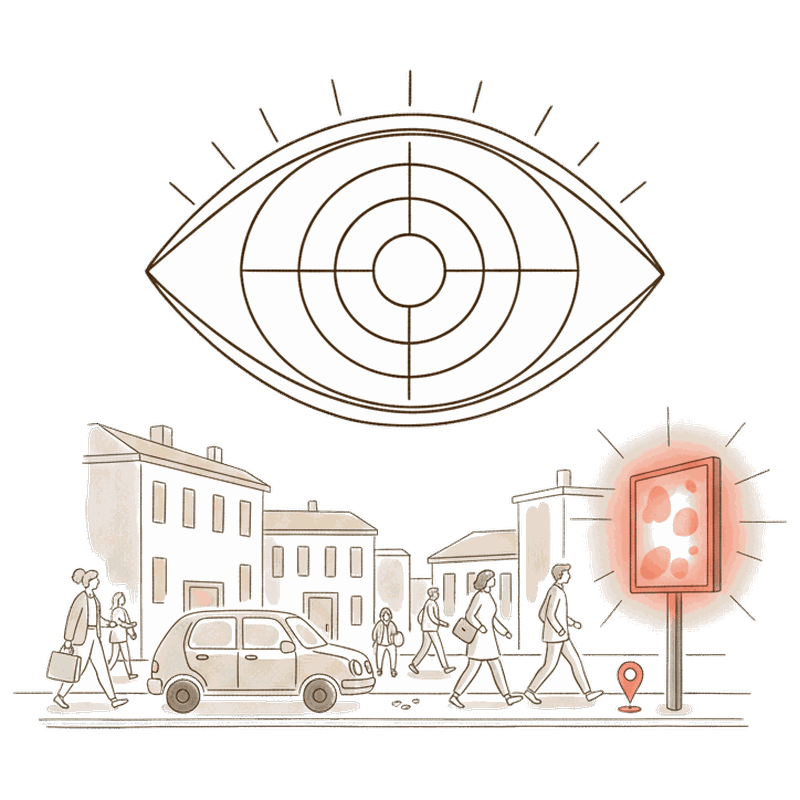
What audience measurement actually means
Every out-of-home screen can tell you how many ads it played. Audience measurement asks a harder question: how many people were actually near enough to see one. The industry answers it with a small number of independent, third-party bodies rather than each platform grading its own homework, the same principle behind television's ratings panels or digital's accredited counts.
The lineage goes back further than digital screens do. The Traffic Audit Bureau (TAB), established in 1934 by the outdoor advertising industry itself, was built to hand advertisers third-party audience data instead of a seller's own estimate, a documented early ancestor of today's Geopath, per the OAAA's own published history of out-of-home advertising.
1,934
Traffic Audit Bureau founded, per the OAAA's history of OOH
5
core campaign metrics Route reports on every buy
Two systems carry that mandate today. Geopath is the industry-standard body for the United States; Route holds the same role in the United Kingdom. Neither is a Blindspot partner or certification, they are the general measurement layer the whole out-of-home industry, Blindspot included, sits on top of. For the wider vocabulary around exposure, reach and attribution, see the measurement topic hub.
Geopath: the US standard
Geopath is a non-profit organization and the United States' industry-standard body for out-of-home audience measurement. Its methodology does not start with a survey, it starts with counting: a metric it calls "circulation," the number of people who pass each individual media unit.
That circulation figure is built from standardized vehicle and pedestrian volume counts, plus bus and train ridership and transit-station traffic, sourced largely from government data such as local Departments of Transportation and local Transit Authorities. It reads closer to a traffic census than a poll.
Geopath's newer measurement layer adds anonymized mobile location data, trip-movement data drawn from mobile devices and connected cars, to estimate how many people pass a given display and to add demographic detail on top of the raw count. That data is tied back anonymously to home locations rather than to identified individuals, a different animal from the resettable, user-controlled identifiers described in our explainer on mobile advertising IDs.
The last refinement is what Geopath calls "visibility" research: converting a raw opportunity to see, someone merely passing the unit, into an estimate of who actually notices the unit or the ad running on it. It is the difference between a screen being technically in someone's field of view and that person's attention actually landing on it.
Route: the UK standard
Route is the United Kingdom's equivalent body: an independent, not-for-profit Joint Industry Currency, or JIC, and the industry-standard system for out-of-home audience measurement there. Like Geopath, it separates a raw count from a visibility estimate, but it builds the count differently.
Route's methodology combines a travel survey with independent count data, used to calibrate that survey, plus a visibility adjustment for likelihood to see, as opposed to a mere opportunity to see. It tracks travel patterns nationally using Multi-Sensory-Tracking (MST) devices, then maps those patterns against every outdoor site in the country: rail and underground stations, shopping centers, supermarkets, airports, roadside sites, buses and taxis.
For the visibility side specifically, Route has partnered with Lumen Research to study how pedestrians actually look at out-of-home formats using eye-tracking, rather than assuming every passerby notices every panel equally.
Route reports five core campaign metrics on every buy: Reach, the unique people who see a campaign; Impacts, the total number of times the ad is seen; Frequency, the average number of times an exposed person sees it; Cover, the proportion of the target audience exposed; and Gross Rating Points (GRPs), the campaign's weight, a target-reach proportion multiplied by average frequency.
Read side by side, the two systems agree on the shape of the problem: count first, then adjust for attention, even though the raw inputs, government traffic data in one case, a national travel survey in the other, look nothing alike.
Visibility research converts a raw opportunity to see into an estimate of who actually notices the ad.
Geopath
Privacy: cameras, consent and what gets stored
Route's eye-tracking work, and any camera-based digital-signage audience counting, raise an obvious question: what happens to the footage. The honest answer, when a system is built well, is that almost none of it is kept.
Well-built digital-signage audience measurement uses anonymous, aggregate counting. The camera feed is processed on-device, individual frames are analyzed and then discarded, and no images or identities are stored anywhere downstream.
The key technical distinction is between face detection and face recognition. Properly built systems perform detection only: is a face present, a broad estimate of age range or gender, nothing more. They do not perform recognition, matching a face to a known identity, and a detection-only system keeps no record that could re-identify a person after the fact.
Because no personal data is retained, this style of measurement is generally compatible with privacy regimes such as GDPR and CCPA, and clear on-site notice that measurement is in use is standard good practice, a framing reflected in industry privacy guidance, such as that published by DOOH platforms like Broadsign in their own public explainer on digital out-of-home and privacy.
Where Blindspot fits in
Geopath and Route both answer a planning question: given everything known about traffic and attention, how many people are likely to see a campaign on a given screen. That estimate matters before a campaign runs. It is not the same question as what a campaign actually did once it ran, which is where Blindspot's own reporting sits.
Blindspot is not certified by, partnered with, or a member of Geopath or Route. It sits alongside them as a separate, delivery-side layer: proof-of-play reporting, a verified record that a given ad actually appeared on a given screen at a given time, logged directly from the screen rather than modeled from traffic counts or a survey.
Blindspot platform data, 2026
- Scale: more than 3,000,000 screens in 50+ countries, all reporting proof of play rather than a modeled audience estimate.
- Pricing: Blindspot prices media by the play, in USD, starting from about $0.23 average cost per play, never CPM, the unit both Geopath and Route report against.
- Delivery reporting: every booked play is logged as it runs, the same proof-of-play principle described in our explainer on what is a play, and connecting that delivery record to a later outcome is the subject of our guide to billboard attribution for D2C.
50+
countries with Blindspot screens reporting proof of play
$0.23
starting average cost per play on Blindspot
The two layers are complementary, not competing. A brand planning a UK campaign might use Route's Reach and GRPs to size the buy, then check Blindspot's per-play pricing on book a billboard or the per-play pricing index to see exactly what a screen costs before booking it. Geopath and Route describe the audience; Blindspot confirms the delivery.
The figures to cite
A quick-reference table mixing the two named measurement bodies with labeled Blindspot platform data. Name the source when you quote a figure. Figures are current as of July 2026.
| Figure | What it measures | Source |
|---|---|---|
| 1934 | Year the Traffic Audit Bureau, Geopath's documented ancestor, was founded | OAAA (published history of OOH) |
| 5 | Core campaign metrics Route reports: Reach, Impacts, Frequency, Cover, GRPs | Route |
| Circulation | Geopath's base audience count, built from traffic and transit data | Geopath |
| Detection, not recognition | Privacy design principle for camera-based audience counting | Industry privacy guidance (e.g. Broadsign) |
| 3,000,000+ | Screens reporting proof of play on Blindspot | Blindspot platform data |
| $0.23 | Starting average cost per play on Blindspot | Blindspot platform data |
Cite this page. Suggested citation: Blindspot, "DOOH Audience Measurement, Explained," seeblindspot.com, July 2026, https://seeblindspot.com/dooh-audience-measurement/. Each measurement-body figure above traces to Geopath or Route; verify against each body's own published methodology before publishing. Updated July 2026.