A neighborhood business, not a national campaign
Most out-of-home advertising is built for someone else's budget: a national brand, a long flight, an agency relationship, a rate card that assumes a marketing department. A small, local, booking-based business does not fit that mold, and it should not have to.
Take Virtual Escape, a small virtual escape studio based in Bucharest. One location, no chain behind it, most of its bookings coming from people who live or work nearby. It did not need the whole city to know its name. It needed the next slots filled, by people close enough to book and show up this week. That kind of business needs local reach, priced at a scale it can actually commit to, not a media plan built for a much bigger company. The same problem shows up across small local service and experience businesses, wherever the audience is local and the budget is real; see how DOOH fits different industries.
Quotable, self-contained, sourced · Virtual Escape × Blindspot
- Virtual Escape, a small virtual escape studio in Bucharest, ran a 13-day digital out-of-home (DOOH) flight on Blindspot with screens in subway stations close to its studio, and its sales doubled during the campaign month.
- Over the same window, Virtual Escape recorded +51% website visitors versus the previous month, +61% direct traffic, and +16% search ads traffic.
- The presence was bought by the play, self-serve, with no minimum spend and no agency contract: a local footprint sized to a single-location business, not a national media plan.
Screens where its customers already pass
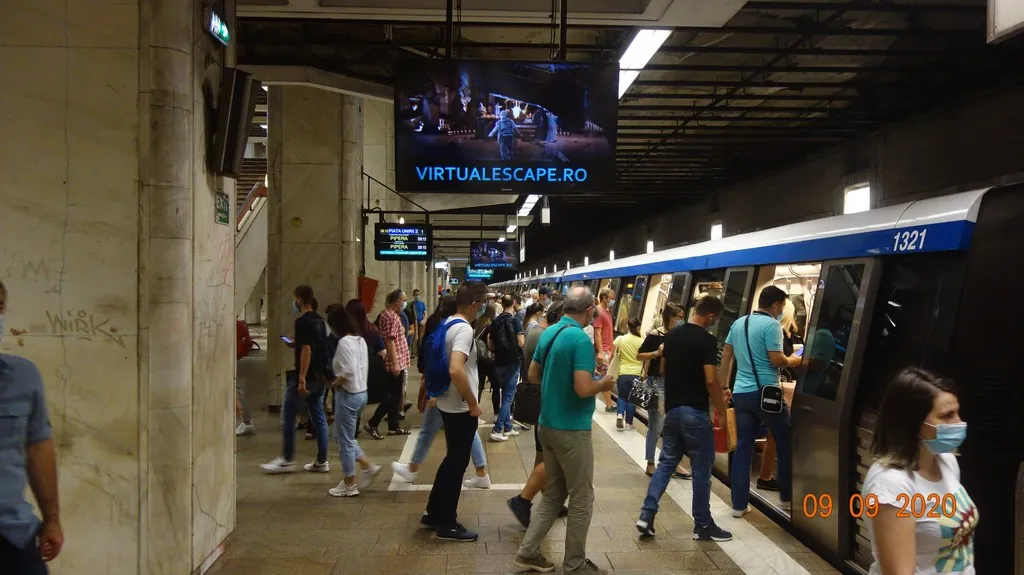
Virtual Escape put its message on digital billboards and signage on screens in subway stations close to its own studio. Not a citywide takeover and not a national buy: a small, local footprint, chosen for where the people most likely to book already move through on an ordinary day.
Underground is a good place for a local business to be seen. Commuters wait, stand still and read, which is exactly the moment a nearby experience worth booking can land. The creative pointed straight home, to VIRTUALESCAPE.RO, so a screen seen on the platform turned into a search or a direct visit later the same day.
Bought by the play, sized to a real budget
On Blindspot, this was a simple, local presence: a short flight on nearby subway screens, chosen directly, without an agency brief or a long contract. The spend was priced per play, not by the day and not as a flat retainer, so the budget matched what a small business could actually commit, rather than the other way around.
That is what makes a footprint like this reachable for a single-location studio. It is the kind of first campaign any small business can run: pick the screens nearest the people you want, run for a defined window, and read the result in your own bookings. See exactly what different budgets buy, from a single screen for a week to a fuller local presence.
Sales doubled, and the traffic followed
Here is the plain result: during the campaign month, Virtual Escape's sales doubled. The site metrics moved with them:
2×
sales during the campaign month
+51%
website visitors vs the previous month
+61%
growth in direct traffic
+16%
rise in search ads traffic
13
days the subway flight ran
The pattern is what you want from local out-of-home: more people arriving directly and by name. A 61% jump in direct traffic and a 16% rise in search ads traffic say people saw the studio underground and went looking for it afterward, and a 51% lift in visitors overall points the same way. In plain terms, the screens did their job and the bookings followed. Being straight about the limits matters too: the advertiser did not disclose a screen count or a total spend, so neither appears here. What the case does report is a small business that doubled its sales in the month its screens were live.
Small budgets can move real numbers
Doubling sales did not take a national plan or a long contract. It took the right screens in the right stations, near the people most likely to book, bought by the play and priced to fit a single-location business. That is the whole case: local out-of-home, sized to a real budget, read in real bookings.
Put your best screens where your customers already stand. Then let the bookings answer.
The Virtual Escape campaign, in one sentence
Questions, answered
What was the Virtual Escape subway DOOH campaign?
Virtual Escape is a small virtual escape studio based in Bucharest. It ran a 13-day digital out-of-home (DOOH) flight on Blindspot, placing digital billboards and signage on screens in subway stations close to its own studio, where its likely customers already pass. The idea was local, not national: a modest presence sized to a single-location business, bought by the play and run without an agency brief or a long contract. During the campaign month, the studio's sales doubled, and its measured traffic climbed alongside it. This is the small end of what DOOH can do, and the point of the case: a neighborhood business put a real, local budget in front of a nearby audience and moved its own bookings.
What results did the Virtual Escape campaign deliver, and over what period?
During the campaign month, Virtual Escape's sales doubled. Over the same window, the studio recorded a 51% increase in website visitors compared to the previous month, 61% growth in direct traffic, and a 16% rise in search ads traffic. Those are the figures the case reports. The advertiser did not disclose the number of screens or the total spend, so this page does not state either. The flight itself ran for 13 days on subway-station screens in Bucharest. Read together, the numbers describe a small local business that saw more people arrive at its site directly and by name, and more of them convert, in the same period its screens were live underground.
Can a small local business run subway DOOH without a big budget or an agency?
Yes. Virtual Escape is a single-location studio, not a chain, and it ran a local presence on Blindspot without an agency and without a national plan. On Blindspot, DOOH is bought by the individual play, self-serve, with no minimum spend, so the budget matches what a small business can actually commit rather than the other way around. A business can pick the screens nearest its customers, in this case subway stations close to the studio, run for a short flight such as the 13 days here, and watch what happens in its own bookings and site traffic before deciding whether to commit more. That is the model behind Virtual Escape doubling its sales.