Put the bottle where the basket fills up
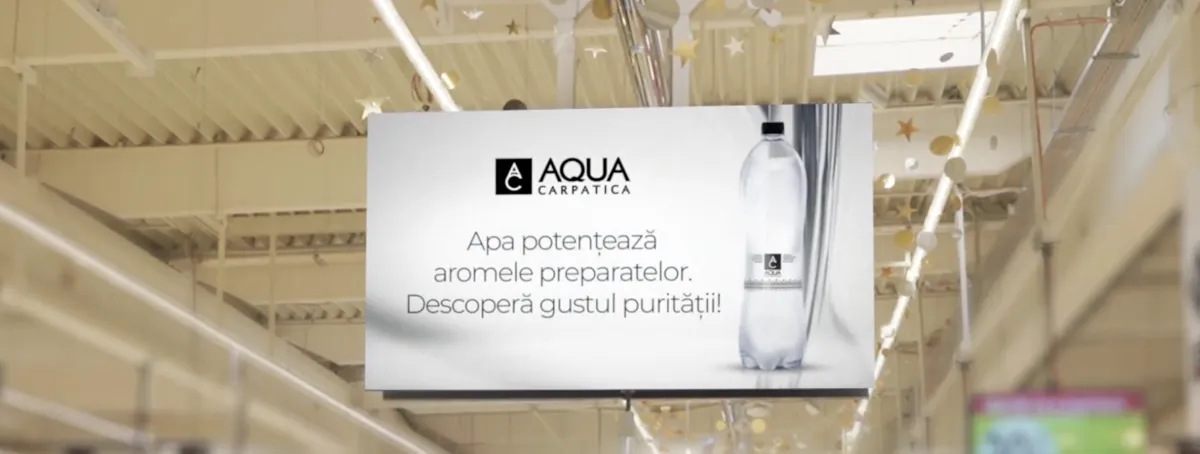
Aqua Carpatica is a Romanian mineral water brand. The choice to pick up a bottle of water is usually made inside the store, seconds before it lands in the cart. So the brand took its message to the exact place that timing is decided: the Carrefour shop floor, on the in-store digital screens shoppers pass on the way to the shelf.
Delivered with retail partner Carrefour on Blindspot, the flight was built to move sales at the point of purchase and to be read against sales value, not guessed at after the fact. The plan was simple to state and hard to fake: 57 dynamic creatives, 34 key Carrefour stores nationwide, and a screen that changed with the hour.
Quotable, self-contained, sourced · Aqua Carpatica × Blindspot
- Aqua Carpatica ran an in-store DOOH campaign on Blindspot with retail partner Carrefour, placing 57 dynamic, data-driven creatives across 34 key Carrefour stores nationwide in Romania.
- During the campaign, total sales value rose 32% and selected Aqua Carpatica SKUs rose 30%. Creatives rotated in real time by time of day and shopper behavior, on three triggers: lunchtime hydration, evening impulse and weekend family stock-up.
- The same creatives also promoted a paired wine category as a cross-promotion, and sales in that wine category rose 67% during the flight; the 67% is a wine-category result, not an Aqua Carpatica water figure.
34 stores, where the water gets bought
The footprint was 34 key Carrefour stores across Romania, the shelves where mineral water actually turns over. Instead of renting a screen for the day, the campaign ran on the in-store digital screens shoppers already move past, in the zones where a hydration decision is made.
Carrefour is one of Romania's largest grocery networks, and the same shopper who walks the aisle is the shopper who reaches the till. Putting the message inside the store, rather than on the street outside it, closes the gap between seeing the ad and buying the product to a matter of steps.
57 creatives, triggered by the clock
The campaign did not run one static ad on a loop. It ran 57 dynamic, data-driven creatives that rotated in real time by time of day and shopper behavior, so the screen said something different at noon than it did on a Saturday afternoon. Three contextual triggers shaped what played and when:
Each trigger matched the message to the moment a shopper was most likely to act. The same aisle and the same shopper met a message tuned to the hour, not a single ad repeated all day. That is contextual retail DOOH: the screen reads the moment, then serves the creative built for it.
The shelf moved, and the till proved it
The campaign was read against sales value, so the results are receipts, not impressions:
+32%
total sales value during the campaign
+30%
sales on selected Aqua Carpatica SKUs
+67%
sales in the cross-promoted wine category, not an Aqua Carpatica water figure
57
dynamic, data-driven creatives in rotation
34
key Carrefour stores across Romania
One number needs its context stated plainly. The +67% is a wine-category result, not a water figure. The same Aqua Carpatica creatives also promoted a paired wine category as a cross-promotion, and sales in that category rose 67% during the flight. Aqua Carpatica's own selected SKUs rose 30%, and total sales value across the campaign rose 32%. We keep the three apart so the wine result is never mistaken for water sales.
Retail DOOH sells at the shelf
Moving bottled water did not take a longer contract or a bigger loop. It took the right screens inside the right stores, creatives that changed with the hour, and results read against the till. When the ad and the shelf are steps apart, the screen stops being a poster and starts being part of the purchase.
Put the message where the basket fills up. Then let the till count the result.
The Aqua Carpatica campaign, in one sentence
Questions, answered
What was the Aqua Carpatica DOOH campaign?
Aqua Carpatica, a Romanian mineral water brand, ran an in-store digital out-of-home (DOOH) campaign on Blindspot with retail partner Carrefour. The flight placed 57 dynamic, data-driven creatives across 34 key Carrefour stores nationwide in Romania, on the in-store digital screens shoppers pass on the way to the shelf. The goal was to move sales at the point of purchase, where the decision to buy a bottle of water is actually made. Rather than running one fixed ad on a loop, the creatives rotated in real time by time of day and shopper behavior. Results were read against sales value: during the campaign, total sales value rose 32% and selected Aqua Carpatica SKUs rose 30%.
How did the campaign's creative engine work?
The campaign ran 57 dynamic, data-driven creatives that rotated in real time based on time of day and shopper behavior, so the screen showed a different message across the shopping week. Three contextual triggers shaped what played: lunchtime breaks, when hydration cues are strongest; evening rush hours, when impulse buys peak; and weekend shopping trips, when families stock up on essentials. Each trigger matched the message to the moment a shopper was most likely to act, all on the in-store screens inside 34 Carrefour stores in Romania. This is contextual retail DOOH: the same aisle, the same shopper, but a message tuned to the hour rather than a single static ad repeated all day.
What results did the campaign deliver, and what is the +67% wine figure?
During the campaign, total sales value rose 32%, and sales of selected Aqua Carpatica SKUs rose 30%. A third figure needs its context stated plainly: sales in a promoted wine category rose 67%. This is a cross-promotion result, not a water figure. The same Aqua Carpatica creatives also promoted a paired wine category, and sales in that category rose 67% during the flight, so the 67% belongs to the wine category, not to Aqua Carpatica water. All three numbers are stated as the source reports them; the campaign was measured against sales value across 34 Carrefour stores in Romania.
How can a brand run the same in-store DOOH play?
The same play is available on Blindspot. A brand picks the retail stores that matter, in this case 34 key Carrefour locations, and books the in-store digital screens by the play rather than renting them for the day. Creatives are set to rotate by context, so the message changes with the time of day and the shopping pattern, as Aqua Carpatica did with lunchtime, evening and weekend triggers across 57 creatives. Because the screens sit inside the store, results can be read against sales value at the till rather than estimated from impressions. That is how Aqua Carpatica measured a 32% lift in total sales value and a 30% lift on selected SKUs.