NYC Billboard Advertising: Launch High-Impact Campaigns Without the Legacy Friction
By the Blindspot Team | Programmatic DOOH Experts | seeblindspot.com
They want transparency in pricing and need campaigns live within days, not after a lengthy production cycle. This guide covers what truly matters: real billboard costs in New York City by location and format, how programmatic DOOH has overtaken the legacy model, strategic inventory beyond Times Square, and how modern measurement tools bring accountability to outdoor advertising. No myths, no inflated reach projections, just the essentials for high-impact campaigns in the world’s most competitive ad market, minus the usual friction.
Table of Contents
Navigate the essentials of New York City billboard advertising without the legacy friction.
- The New Standard for NYC Billboard Advertising
- NYC Billboard Costs: From Times Square to the Outer Boroughs
- Why Programmatic DOOH is Replacing Legacy Buying
- Strategic Inventory: Beyond the Times Square Hype
- Data-Driven Outdoor: Measuring What Matters
- Launch Your NYC Campaign in Minutes, Not Months
Key Takeaways
- Billboard costs in New York City range from $150 for outer borough digital rotations to $50,000+ per month for Times Square placements—understanding this is key to efficiency.
- Programmatic DOOH has replaced the legacy model. Pay-per-play pricing, real-time targeting, and creative agility are now standard.
- While Times Square commands a premium, outer boroughs and commuter corridors offer comparable audiences at a fraction of the CPM.
- Foot traffic lift, attribution data, and cost-per-play metrics finally bring accountability to outdoor advertising, akin to paid social.
- Modern platforms launch campaigns in days—no RFPs, no agency markups, no lengthy production cycles.
The New Standard for NYC Billboard Advertising
NYC billboard advertising isn’t flawed—the purchasing method is.
With over 1.5 million daily impressions in Times Square alone, New York is the most competitive ad market globally. This scale should be an advantage, but legacy buying turns it into a bottleneck. Manual RFPs, four-week commitments, and upfront production fees delay campaigns until their cultural relevance fades.
Modern growth teams can’t afford a 30-day lag. They’re running paid social with same-day iteration, adjusting budgets mid-flight, and targeting by behavior—not just zip code. NYC billboard advertising rates should match this flexibility.
They can now. Programmatic DOOH has arrived in Manhattan. Automated platforms using real-time data allow for pay-per-play pricing, micro-buying windows, and contextual triggers tied to weather, foot traffic, and time of day. The same agility you experience in a Facebook Ads dashboard is now available for a screen in SoHo or the West Side Highway. See this precision in action when targeting aligns with location behavior.
The old OOH model was designed for brand managers with unlimited lead time—not performance marketers who need results now.
NYC Billboard Costs: From Times Square to the Outer Boroughs
NYC billboard advertising rates cover a broad spectrum—knowing where to look is crucial.
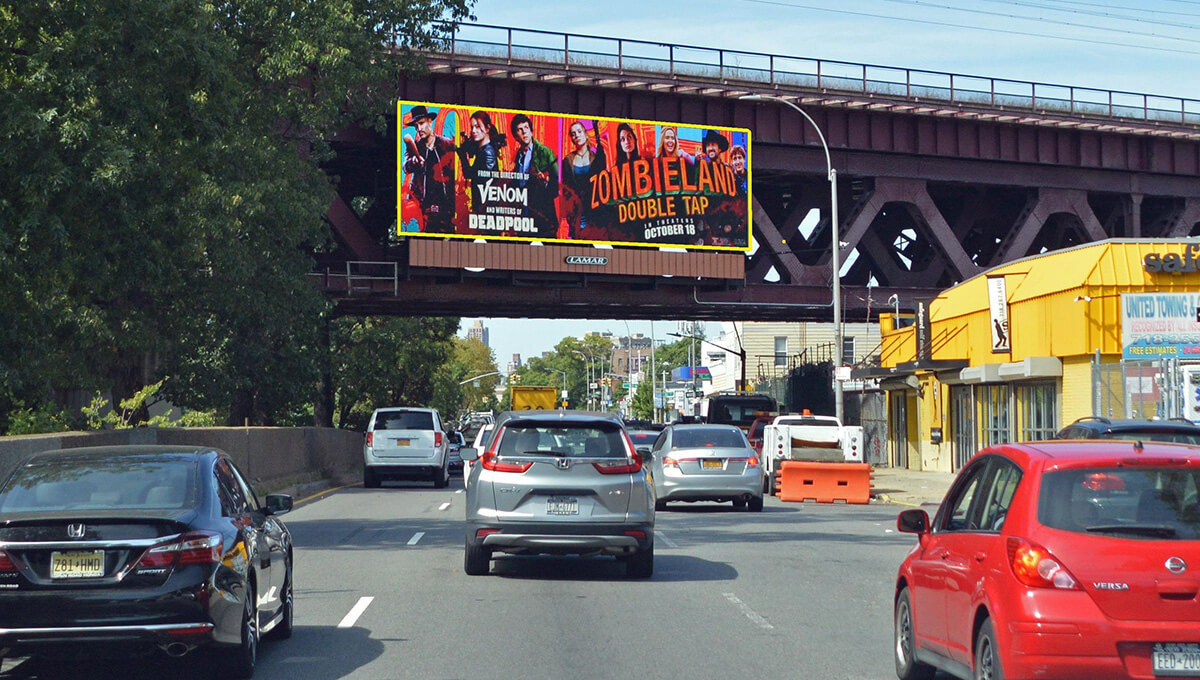
Times Square’s Bowtie district demands premium rates due to density, dwell time, and prestige. Standard digital rotations range from $10,000–$50,000+ per month. Commuter corridors like the Long Island Expressway offer a different value proposition. Digital spots in these areas can start at $150, making visibility attainable for brands beyond the Fortune 500.
Format impacts cost as much as location. Static wallscapes offer exclusive 24/7 visibility, one brand, one message, no rotation. Digital displays operate on a shared model, rotating multiple advertisers. Here’s a quick reference:
| Location | Format | Estimated Monthly Cost |
|---|---|---|
| Times Square (Bowtie) | Digital rotation | $10,000–$50,000+ |
| Midtown / Major Avenues | Digital rotation | $2,000–$8,000 |
| LIE / Outer Borough Commuter | Digital rotation | $150–$1,500 |
| Manhattan Wallscape | Static | $5,000–$25,000+ |
Cost per play—the price of a single creative display within a rotation loop—reveals what you’re truly paying for in digital advertising. Total flight cost obscures efficiency.
Legacy buying adds hidden costs: production fees, agency markups, and 30+ day lead times that hinder campaign agility.
The solution? Programmatic DOOH is dismantling that outdated model entirely.
If cost transparency is your priority, the right buying method matters as much as location.
Why Programmatic DOOH is Replacing Legacy Buying
Programmatic DOOH reduces billboard costs in NYC without sacrificing reach—by allowing you to purchase exactly what you need, when you need it.
Traditional outdoor buying involves a four-week block commitment, a 20–30% agency markup, and a 30+ day wait to go live. Programmatic DOOH flips this. You control the schedule, creative, and spend in real-time.
Here’s how it works:
Flexibility
- Swap creatives based on weather, time of day, or live events—no production delays
- Pause or redirect spend as campaign data changes
Targeting
- Schedule by daypart: run only during morning commutes or Friday evenings
- Use POI targeting to activate screens near retail locations, competitor storefronts, or high-traffic venues
Speed
- Launch from brief to live in days, not months
- Eliminate middleman markups—direct programmatic buying means your budget reaches screens, not agency overhead
According to Vistar Media, programmatic platforms let advertisers pause, pivot, or optimize campaigns in minutes—a capability legacy buying cannot match.
If your media budget is tied to 30-day static commitments, you’re paying for unmeasurable reach and unneeded time slots—discover where smarter inventory thrives.
Strategic Inventory: Beyond the Times Square Hype
Smart NYC advertisers don’t chase the biggest billboard—they choose the right one. Times Square captures headlines, but rarely the best ROI. The strategic play is aligning inventory type with audience behavior.
Transit is crucial. MTA subway and bus networks reach millions daily, making station dominations and bus shelter placements high-frequency touchpoints. You’re not interrupting—you’re engaging during dwell time when attention is available.
“Street furniture and LinkNYC screens let you own a neighborhood, not just a demographic. SoHo, Williamsburg, Astoria—you can target a 10-block radius with surgical precision.”
For premium audiences, the West Side Highway corridor is undervalued. High-net-worth commuters and residents frequent this stretch. Digital billboards in NYC consistently perform well for finance, luxury, and real estate sectors.
“Brooklyn and Queens offer CPMs that Manhattan can’t touch—and the lifestyle audiences there are just as valuable to the right brand.”
The outer boroughs aren’t a fallback. For food, fitness, fashion, and culture brands, Brooklyn and Queens provide authentic reach at a reduced cost. Understanding how programmatic buying operates across this inventory distinguishes efficient campaigns from costly ones.
Choose inventory based on actual audience movement—not where ad folklore suggests.
Data-Driven Outdoor: Measuring What Matters
Programmatic DOOH bridges the measurement gap that left traditional billboard buyers in the dark. The outdated metric—”estimated impressions” based on traffic counts—is obsolete. Modern platforms provide verified play logs: timestamped proof of when, where, and for how long your creative ran. This standard matches digital ad accountability without sacrificing physical reach.
Here are the four metrics that really matter for NYC campaigns:
- Verified play logs—Confirmed delivery data per screen, per slot, per second.
- Foot traffic lift—Mobile location data showing how many exposed users visited your storefront post-ad exposure.
- Brand lift surveys—Polls for users near your screens, measuring recall and purchase intent shifts.
- Digital retargeting audiences—Device IDs captured near your billboard, integrated into your existing ad stack for follow-up campaigns.
Foot traffic lift is critical. By cross-referencing anonymized mobile signals with billboard exposure, platforms can determine if your NYC campaign drove people through the door—not just past it. For retailers, QSRs, and local service businesses, this metric alone justifies the spend.
The best part: all this integrates with dashboards you already use. Learn how these tools connect when building your first campaign.
If you can’t measure it, you can’t scale it—with programmatic DOOH, measurement is now possible.
Launch Your NYC Campaign in Minutes, Not Months
NYC billboard advertising doesn’t require a six-figure retainer or a lengthy lead time—just three steps.
Stop waiting for an agency to return your call with inflated Times Square billboard cost estimates and vague reach projections. Here’s the process:
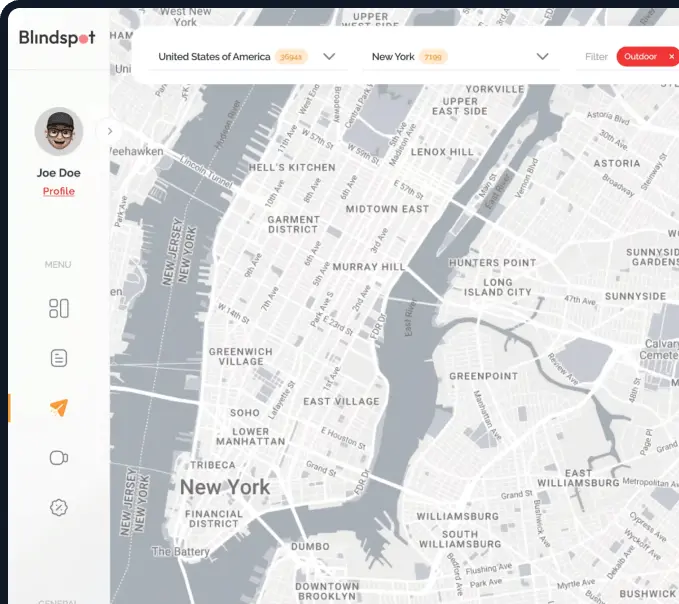
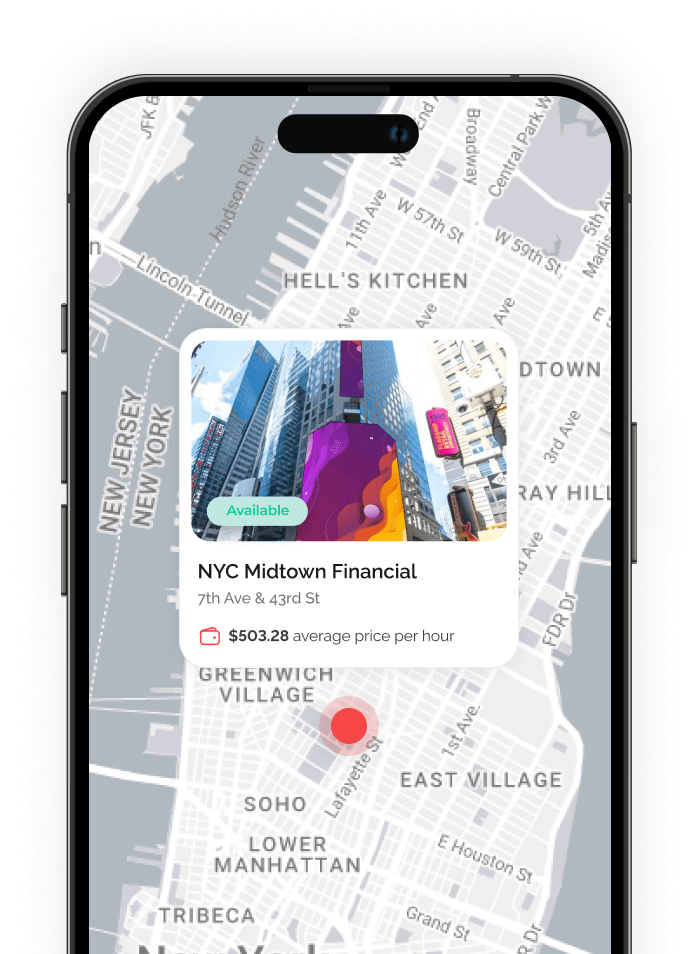
- Use the AI Media Planner to select high-impact NYC locations—filtered by foot traffic, POI proximity, and audience behavior, not gut instinct.
- Upload your creative and set contextual triggers—weather conditions, time of day, live events—ensuring your message hits when it’s most relevant.
- Go live and optimize in real-time. Adjust spend, swap creatives, or pause underperforming placements without picking up the phone.
As Blindspot puts it: booking billboard ads should be as easy as booking an Uber. That’s not just a tagline—it’s the operational reality legacy buyers never achieved. Brands already running programmatic DOOH campaigns this way see measurable performance outcomes, not just impressions.
The friction was always the process, not the medium. NYC’s billboard inventory is powerful—it just needs a smarter on-ramp.
Don’t let a legacy buying process cost you market momentum—launch, measure, and optimize on your own terms.
Key DOOH Terminology
Programmatic DOOH. Pay-per-play. Micro-buying. Familiar if you’re from paid social; foreign if you’re from traditional OOH. Here’s the quick rundown:
Programmatic DOOH—Digital out-of-home inventory bought via automated platforms using real-time audience and contextual data. No RFPs. No phone calls. You set parameters, the platform executes.
Pay-per-play—Payment for each creative display on screen. Not per month. Not per panel. Per play. This pricing model finally holds digital billboards accountable.
Micro-buying—Short-duration, flexible ad purchasing—down to specific dayparts or hours. Run Friday evening only. Pause Sunday. Restart Monday morning. Legacy OOH can’t compete.
POI Targeting—Activating screens near specific points of interest: your retail locations, a competitor’s storefront, or a venue where your audience just spent three hours. Proximity-based, behavior-informed, and more precise than zip code targeting.
Dayparting—Scheduling ads to run at specific times of day for optimal audience engagement.
CPM—Cost per thousand impressions. A standard metric reflecting the cost of reaching 1,000 viewers.
Know these terms. They’re the difference between buying OOH like it’s 2010 and running it like a performance channel.
NYC Billboard Advertising FAQ
How much does a Times Square billboard cost?
Costs vary, ranging from $10,000 to over $50,000 per month depending on location and format.
What are the benefits of programmatic DOOH?
Programmatic DOOH offers flexibility, real-time targeting, and cost efficiency, allowing advertisers to optimize campaigns on the fly.
How quickly can I launch a billboard campaign in NYC?
With programmatic DOOH, campaigns can go live in days, bypassing traditional agency delays.
Why choose Blindspot for DOOH advertising?
Blindspot provides a seamless, data-driven approach to DOOH, ensuring precision targeting and measurable outcomes.
Why Blindspot
Blindspot is tailored for performance marketers—not the legacy OOH agencies. The platform provides direct access to premium NYC inventory, from Times Square billboards costing $10,000–$50,000+ per month to outer borough placements starting under $1,000. No agency markup, no minimum commitments, no 30-day lead time. The AI Media Planner handles targeting.
The shift toward programmatic digital out-of-home (pDOOH) is a fundamental market evolution. According to the Out of Home Advertising Association of America (OAAA), OOH advertising reached a record $9.46 billion in 2025, with digital serving as the primary growth engine.
Modern brands choose this model for three reasons:
- Precision & Accountability: Unlike legacy OOH, pDOOH leverages mobile location data and in-screen sensors to provide measurable attribution, including footfall traffic and store visits.
- Agility: Automated demand-side platforms (DSPs) allow brands to launch campaigns in days rather than months and optimize budgets in-flight based on real-time performance.
- Proven Value: 91% of media agencies and 84% of advertisers recognize pDOOH as offering excellent value and effective ROI.
Verified by OAAA and IAB industry standards.
Data Methodology & Sources
To ensure accuracy in billboard costs and impression data, we aggregate information from:
- Geopath: The standard for OOH audience measurement, providing audited “eyes-on” impression data for NYC transit and roadside inventory.
- OAAA (Out of Home Advertising Association of America): Historical rate benchmarks and category growth trends for the NYC market.
- Times Square Alliance: Real-time pedestrian counts and dwell-time metrics for the Bowtie district.
This guide is based on real-time platform data from Blindspot’s proprietary inventory management system, covering active digital billboard locations across New York City. Cost estimates reflect average CPMs and spot-rate data from Q1 2026. We cross-referenced these figures with industry benchmarks from OAAA and Geopath audience measurement standards to ensure accuracy and neutrality. By combining these sources with Blindspot’s real-time programmatic clearing rates, we offer a transparent view of the NYC market, bypassing traditional agency markups. For performance attribution, we employ viewshed mapping and exposed vs. control cohort analysis to isolate the specific impact of billboard exposure on digital conversions and foot traffic.
About the Author
This guide was produced by the Blindspot Strategy Team. Our practitioners have managed over $50M in programmatic DOOH spend across the NYC market, specializing in transitioning legacy brands to data-driven outdoor strategies. Our work on OOH innovation has been featured in leading industry publications including AdExchanger and Digiday.
Case Study: Adore Me
The Challenge: As a high-growth DTC brand, Adore Me needed to move beyond “spray and pray” legacy marketing to a personalized, data-driven approach that could scale with their rapid growth. The Strategy: The brand transitioned from static, manual media buying to automated, audience-targeted campaigns using predictive modeling and multi-channel integration across the NYC market. The Results: By shifting to automated, data-led programmatic campaigns, Adore Me achieved a 775% increase in incremental lift while significantly reducing the operational friction typical of traditional NYC billboard buying.