Why humor lands outdoors
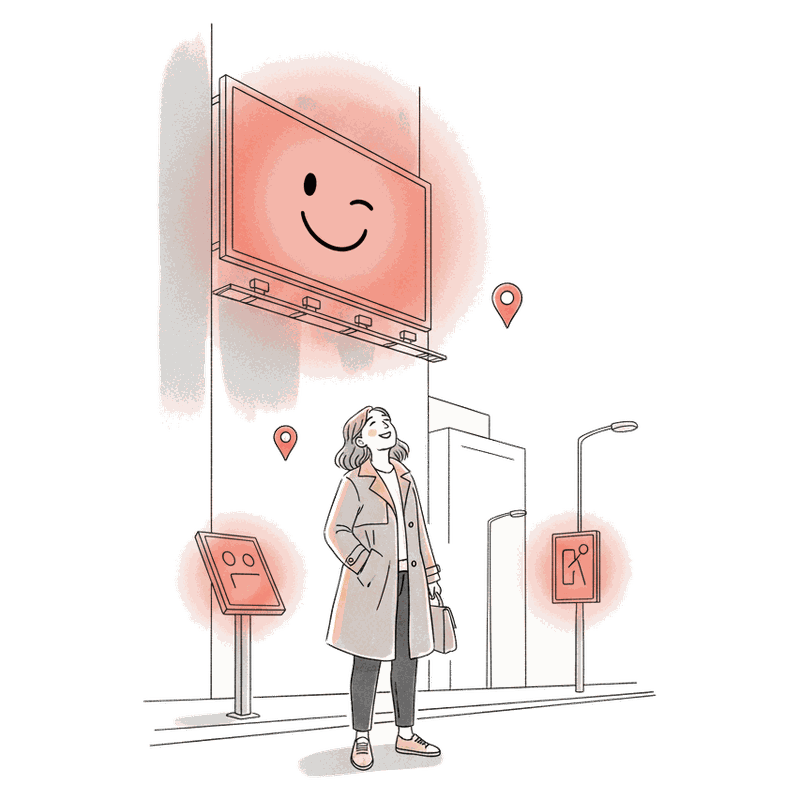
A billboard is the one ad nobody chose to see. There is no scroll bar, no skip button, and no sitting still to read it. A person walking or driving past gives it a glance, a second or two, and then it is gone. Most ads lose that moment. A funny one wins it, because a joke gives the eye a reason to stay: you read the line, you get the turn, you smile. That small reward is the whole trick. It converts a passer-by into a reader by giving them something in return for their attention.
Humor also carries three advantages that suit the street. It is memorable: a message that made you smile is the one you can recall an hour later, when a plain claim has already faded. It is low-avoidance: you cannot look away from a whole street, and unlike an online ad there is nothing to close. And it is shareable: a genuinely funny board gets photographed and posted, so the reach spreads past the people who physically walked by. The one condition is that the joke must sell the product, not just be a joke. A laugh that leaves no trace of the brand is a laugh the budget paid for and lost.
The rules of a funny billboard
Funny is hard, and it is harder outdoors, where you have no time and no second chance to explain. The good news is that the rules are few and they are unforgiving in a helpful way: follow them and a simple idea can carry a whole street. The five below are the difference between a board people quote and a board people miss.
The trap most funny boards fall into is trying to be too clever. A joke that needs a setup and a payoff in two separate sentences is a joke for a page, not a street. Cut it until one line does the work, and let a strong image do the rest. If you are staring at a blank frame, start from the product's most honest quirk and poke at it: the truest jokes in advertising are usually the brand laughing at itself. When the words and the picture pull the same way, you get a board that reads in a second and lingers for an hour. Our billboard design guide covers the layout side, and the creative topic hub gathers the rest.
The best joke on a street is the one you can read at a glance.
The rule under all the rules
Humor on digital screens
On a static poster the joke is fixed the day it goes up. On a digital screen the creative is a file, not paint, so the punchline can move. That opens a kind of humor a paper board can never do: the joke can be timely. A gag that only works on a Monday can run only on Mondays. A weather joke can wait for the weather. A rivalry line can appear the morning after the match. The screen shows the right punchline at the right moment and swaps it out when the moment passes, and the same frame can carry a different joke by daypart.
This is where humor and timing meet. Blindspot lets a creative fire on live conditions on top of the hours you booked: weather and temperature, air quality, stock and crypto prices, live sports scores, and a custom live-data feed for anything else you can measure. You set the rule once, for example show the umbrella gag only when it is raining, and the screen swaps the message in and out as the world changes. A joke that arrives exactly when it is true is funnier than the same joke on a random Tuesday, and it feels less like an ad and more like the street noticing what you noticed.
How to run one on Blindspot
3M+
screens to be funny on
50+
countries covered
$40
where self-serve starts
24
hours a day you can daypart
Running a funny board is the same self-serve flow as any other campaign, so the punchline is the only hard part. You open the map, pick the screens where your audience is, and upload the creative. The unit is the play, one ad appearance on one screen, and the per-play price is shown on every screen card before you book. Average cost per play runs from about $0.23 in urban markets up to a few dollars on premium screens, it is per play rather than per thousand impressions, and there is no minimum spend, so a small local joke can run for the cost of a coffee round while a bigger idea spans thousands of screens. Self-serve starts from about $40.
Then you set the timing, and this is where a digital joke earns its keep. Daypart each screen to the hours its audience is actually out, so the gag runs at the commute or at lunch and not at 3am to an empty street, and layer a live trigger if the joke depends on the weather or a score. If you would rather not build all of that by hand, Blinky, the free AI planner, reads a one-line brief and proposes the screens and the schedule for you, which you then adjust. For the writing itself, keep the design guide open, and when the punchline is ready, browse screens or start building. New to it all? The first-campaign walkthrough and what a billboard costs cover the basics.